Why Extreme Vehicles Push Engineering to Limits
Normal vehicles face normal problems: rain, heat, cold, traffic, potholes. Extreme vehicles face impossible problems: no atmosphere (Moon), -100°F temperatures shattering metal (Antarctica), 140-million-mile remote operation with 20-minute communication delays (Mars), or transitioning from land to water while carrying troops (amphibious vehicles). These aren't challenges you solve with better tires or stronger engines—they require completely reimagining what vehicles can be.
Lunar rovers operated in vacuum with no air for cooling, 1/6th gravity affecting traction and handling, temperature swings of 500°F between sunlit and shadowed areas, and moon dust so abrasive it destroyed seals and joints. Mars rovers communicate with Earth across 140 million miles—20-minute one-way signal delays mean they must think for themselves, making autonomous decisions without human guidance. Antarctic trucks operate where diesel fuel gels solid, batteries lose 60% capacity, rubber becomes brittle glass, and breakdowns aren't inconvenience—they're life-threatening emergencies in -100°F darkness.
These eight vehicles reveal what engineers accomplish when facing conditions that shouldn't allow vehicles to exist: solving problems through innovation (battery thermal management for Moon), redundancy (backup systems for everything), specialized materials (titanium, carbon fiber, special alloys), and accepting extreme costs (Mars rovers cost $2.5 billion each). Extreme vehicles don't just work in harsh conditions—they enable human exploration of places we biologically cannot survive, extending human reach beyond our natural limits through mechanical ingenuity.
What makes extreme adventure vehicles different?
Extreme adventure vehicles operate where humans barely survive or cannot survive at all. Lunar rovers drove on the Moon in 1/6th gravity with no atmosphere and 500°F temperature swings between sun and shade. Mars rovers operate autonomously 140 million miles from Earth with 20-minute communication delays. Antarctic trucks survive -100°F where metal shatters, fuel gels, and breakdowns mean death. These vehicles solve engineering problems that do not exist on Earth—reimagining every component for impossible conditions.
1. Lunar Rover (Apollo Moon Buggy) - Driving in 1/6th Gravity
What It Is
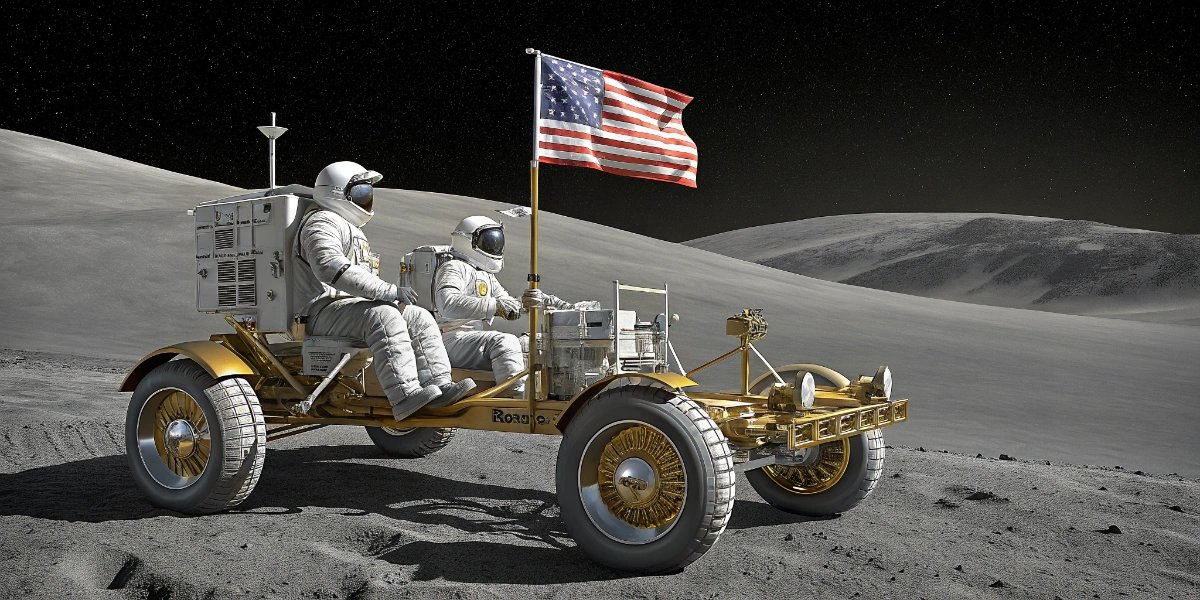
The Lunar Roving Vehicle (LRV) was battery-powered vehicle used during Apollo 15, 16, and 17 missions (1971-1972), allowing astronauts to explore several miles from landing sites rather than short walks. Weighing just 460 lbs on Earth (77 lbs on Moon due to 1/6th gravity), it carried two astronauts plus equipment totaling 1,080 lbs. Powered by four 0.25 HP electric motors (one per wheel), it reached 8 mph maximum speed and operated for 3-4 hours per battery charge. The LRV folded to fit in Lunar Module storage, deployed by astronauts on Moon's surface.
Why It Matters
Engineering for impossible conditions: Moon has no atmosphere (no air cooling for motors/batteries), extreme temperature swings (250°F in sunlight, -250°F in shade—500°F total swing), and abrasive moon dust coating everything. Normal vehicle designs fail instantly: rubber tires would explode/freeze, conventional batteries would fail, and engines requiring air couldn't run. LRV solved these: wire mesh tires (no air needed), sealed motors preventing dust contamination, thermal control systems managing temperature extremes, and battery chemistry designed for vacuum conditions. Every component was reimagined for environment that destroys Earthly assumptions.
Max Speed on Rough Terrain (MPH)
1/6th gravity handling challenges: Low gravity means less weight pressing tires down—reducing traction and making vehicle "float" over terrain rather than grip it. This creates counterintuitive handling: acceleration/braking must be gentle (wheels spin/skid easily), turning requires slower speeds (vehicle tips more easily), and rough terrain sends vehicle airborne unexpectedly. Astronauts reported LRV "bouncing" over rocks—all four wheels leaving ground simultaneously. Driving on Moon required learning entirely new vehicle dynamics. Earth driving experience didn't transfer—different gravity creates different physics.
Expanding exploration range: Without LRV, astronauts could only walk 1-2 miles from Lunar Module (oxygen/safety limits). With LRV, they explored 4+ miles radius—expanding accessible Moon surface area by 16x. This range increase changed science possible: collecting samples from diverse geological areas, reaching interesting features (craters, mountains) that would be unreachable walking, and conducting mobile experiments while moving. LRV transformed Moon missions from small-area exploration to regional surveys—enabling better science through mobility.
Cultural Significance
Lunar rovers represent peak of 1960s-70s space optimism—belief that humans would establish Moon bases, drive vehicles across lunar surface regularly, and expand into solar system. Three LRVs remain on Moon today (Apollo 15, 16, 17 landing sites)—artifacts of that optimism frozen in time. They symbolize what humans accomplished during space race: engineering solutions to problems never faced before, spending whatever necessary for exploration, and achieving seemingly impossible goals. LRV is monument to "we can do this" mentality that put humans on Moon.
Fun Facts
- Top speed 8 mph—astronauts exceeded this, hitting 11.2 mph downhill (unofficial "lunar land speed record")
- Wire mesh tires (woven steel wire)—never went flat, no air to leak in vacuum
- Total mission distance: 56 miles combined across three Apollo missions
- Cost $38 million (1971 dollars)—equivalent to $280 million today, for three vehicles
- One LRV fender broke (kicked up dust)—astronauts repaired it with duct tape and maps, improvised fix broadcast on TV
- Still on Moon today—will remain for millions of years, no weather to decay them
Teaching Moment
Lunar rovers teach about engineering for extreme conditions, solving problems that don't exist on Earth. Kids learn that "driving" isn't universal—different gravity, no air, extreme temperatures all require completely rethinking vehicle design. Also demonstrates that exploration requires mobility: walking astronauts could only explore tiny areas, but rovers expanded accessible Moon surface by 16x. Understanding that tools extend human capabilities beyond biological limits shows why humans develop technology—not just for convenience but for reaching places we otherwise couldn't go. Finally, teaches about iteration and problem-solving: broken fender repair with duct tape shows that even carefully engineered systems need improvisation when unexpected problems arise.
2. Mars Rover (Perseverance) - Autonomous Operation 140 Million Miles Away
What It Is
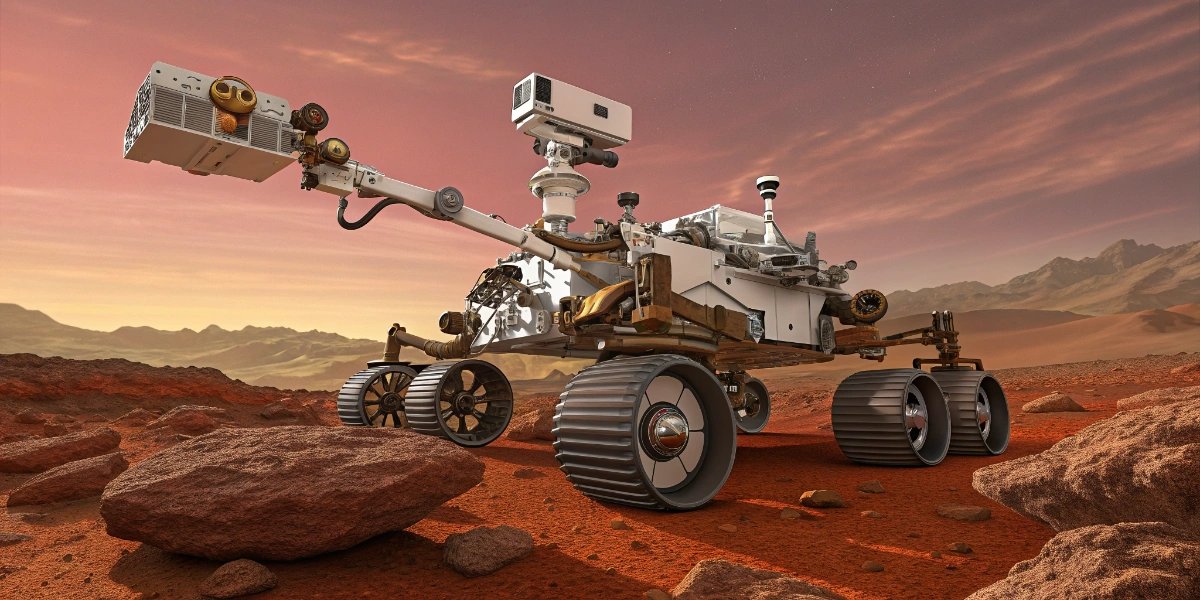
Perseverance is NASA's most advanced Mars rover, landing February 2021 and still operating. Size of small car (10 feet long, 7 feet wide, 2,260 lbs), powered by nuclear generator (Multi-Mission Radioisotope Thermoelectric Generator—MMRTG) producing constant 110 watts for 14+ years. Communicates with Earth across 140 million miles average distance with 20-minute one-way signal delays. Equipped with 19 cameras, robotic arm with drill, sample collection system, weather station, and autonomous navigation software. Designed for 2-year mission but expected to operate 10+ years like previous rovers (Opportunity lasted 15 years vs 90-day design).
Why It Matters
Autonomous decision-making necessity: 20-minute one-way communication delay means round-trip command-response takes 40 minutes. If rover encounters obstacle and stops, waiting 40 minutes for human guidance wastes precious time. Solution: autonomous navigation software (AutoNav) allowing rover to "think for itself"—detecting obstacles, planning routes around them, and continuing without human commands. This autonomy is necessary not luxury: Mars exploration would be impossibly slow if every decision required Earth approval. Perseverance makes hundreds of autonomous decisions daily—showing that distant exploration requires machine intelligence, not just remote control.
Nuclear power enabling years-long missions: Solar panels work on Mars but dust storms can block sun for weeks, killing solar-powered rovers. Nuclear generator produces constant reliable power regardless of weather, day/night, or dust conditions. This enables: year-round operations (no winter shutdown), continuous scientific instruments (always powered), heating systems preventing freezing (-100°F Martian nights), and long mission durations (MMRTG lasts 14+ years vs solar panels degrading yearly). Nuclear power is expensive ($75+ million for MMRTG alone) but enables missions impossible with solar. It's strategic choice: spend more upfront, operate longer.
Sample collection for future return: Perseverance's primary mission is collecting rock/soil samples, sealing them in tubes, and leaving them on Mars surface for future mission to retrieve and return to Earth (planned 2030s). This "cache and return" strategy acknowledges limitation: current technology can send rovers but not bring samples back. Building half the mission now (collection) and planning other half later (return) represents long-term thinking—missions spanning decades, accepting that we're building first stage of multi-stage plan. It's patient incremental approach: do what's possible now, enable what's possible later.
Cultural Significance
Mars rovers represent sustained American commitment to space exploration despite budget constraints and political changes. Since 1997, NASA has continuously operated rovers on Mars (Sojourner, Spirit, Opportunity, Curiosity, Perseverance)—28 years of uninterrupted Martian presence. This consistency through multiple presidents and Congresses shows space exploration as bipartisan priority. Rovers also demonstrate that exploration doesn't require humans physically present: robots can explore alien worlds while humans safely remain on Earth. Whether this is good (safety, cost) or bad (losing human adventure spirit) is debated—but rovers prove robotic exploration works.
Fun Facts
- Perseverance carries Ingenuity helicopter—first aircraft to fly on another planet (April 2021)
- Nuclear generator uses plutonium-238—not weapons-grade, purely power generation
- Top speed 0.1 mph (152 meters per hour)—incredibly slow, moves cautiously analyzing terrain
- Communicates via Mars orbiters—relaying signals to Earth, can't directly communicate (too far)
- Carries piece of Mars meteorite—rock that came to Earth, returned to Mars (sentimental inclusion)
- Wheels are smarter—designed learning from Curiosity's wheel damage, reinforced against sharp rocks
Teaching Moment
Mars rovers teach about remote operation, autonomous systems, and patient long-term planning. Kids learn that exploration doesn't always require humans—robots can go where we can't survive. Also demonstrates communication delays: when controlling something 140 million miles away, you can't joystick it in real-time—it must think for itself. Understanding autonomous decision-making builds appreciation for computer intelligence and problem-solving. Finally, teaches about long-term missions: Perseverance is collecting samples for return mission decades away—showing that some goals require patience and multi-generational planning. Not everything happens quickly; some achievements take decades of sustained effort.
3. Antarctic Tracked Vehicle (Hägglunds BV206) - Survival in -100°F
What It Is
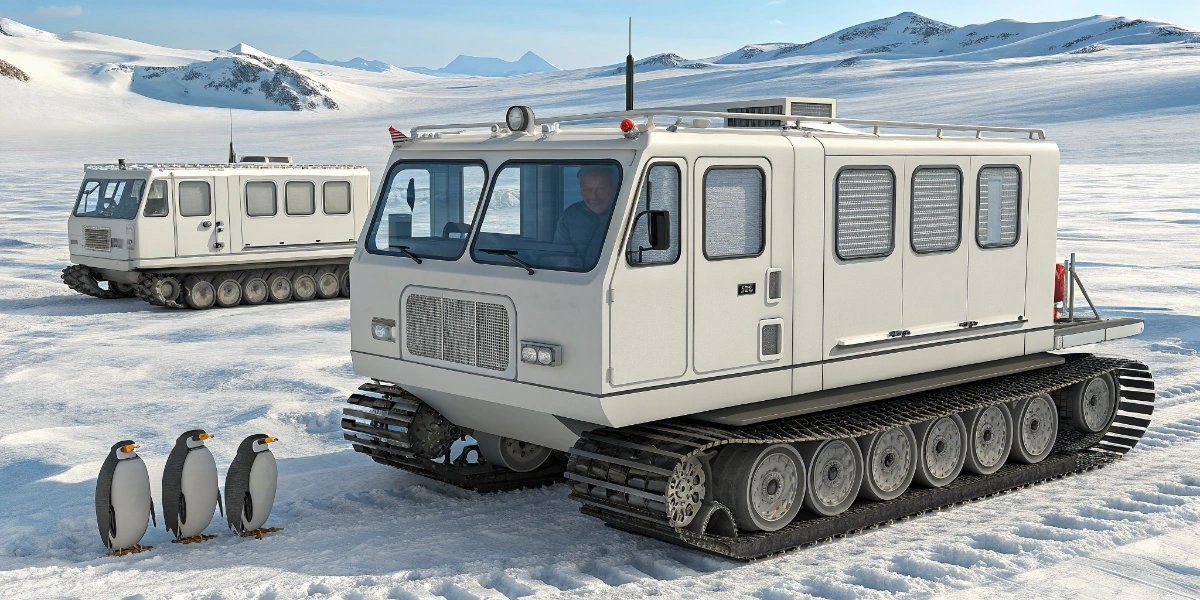
The Hägglunds BV206 is articulated tracked vehicle (two units connected by steering joint) used by Antarctic research programs for transportation across ice and snow. Swedish-made, designed for Arctic military operations but widely used in both polar regions. Fully enclosed heated cabin, tracks instead of wheels for ice/snow traction, articulated design allowing one unit to climb while other anchors, and diesel engines with arctic-grade fuel additives preventing gelling. Carries 8-12 people plus cargo, operates reliably to -60°F (with preparation, handles -100°F), and includes survival equipment since breakdowns in Antarctic mean life-threatening emergency.
Why It Matters
Extreme cold engineering challenges: At -100°F, normal vehicles fail catastrophically: diesel fuel gels into wax (won't flow), batteries lose 60%+ cranking power (can't start engines), metal becomes brittle (parts shatter), rubber seals become rigid glass (leak), and lubricants solidify (bearings seize). BV206 addresses these: arctic diesel additives (prevent gelling), battery heating systems (maintain warmth), specialized lubricants (stay liquid to -60°F), heated engine blocks, and redundant systems (backup heaters, spare parts). Every component is selected for extreme cold—nothing standard works in Antarctic conditions.
Articulated design advantages: Two-unit articulated design (front and rear units connected by steering joint) provides flexibility impossible with single-body vehicles: one unit climbs over obstacle while other provides anchor, units follow different angles on rough terrain (won't beach on obstacles), and tight turning radius despite long overall length. This articulation is essential for chaotic ice/snow terrain where obstacles (pressure ridges, crevasses, drifts) constantly require maneuvering. Single-body vehicles would get stuck; articulated design flows over irregular terrain like mechanical caterpillar.
Survival equipment necessity: BV206s carry extensive survival gear: sleeping bags, emergency food/water, satellite communications, GPS beacons, spare fuel, and emergency heating. This isn't optional caution—it's survival necessity. Antarctic weather changes instantly: clear skies become whiteout blizzards in minutes, making navigation impossible and stranding vehicles. When this happens (regularly), crew must survive until rescue arrives—possibly days. Vehicle isn't just transportation; it's mobile survival shelter. Without proper equipment, breakdowns or weather delays become fatal. Antarctic operations accept this reality: preparation prevents deaths.
Cultural Significance
Antarctic vehicles represent international scientific cooperation—continent is reserved for research under Antarctic Treaty (1961), with no military conflict or territorial disputes. Vehicles from various nations (US, Russia, UK, Norway, China, Australia) all operate peacefully doing science. This cooperation demonstrates that humans can work together in extreme environments focusing on knowledge rather than conflict. Antarctic research requires cooperation: climate too harsh for any single nation to dominate, shared weather/communication systems benefit everyone, and rescue operations cross national lines. BV206s are tools enabling this cooperative enterprise—scientific vehicles, not military ones.
Fun Facts
- Tracks distribute weight over large area—preventing breaking through ice crust covering crevasses
- Articulated joint steers vehicle—rear unit follows front unit's tracks automatically
- Swim capability—BV206 floats and propels through water using tracks (slowly—2 mph in water)
- Used in Arctic and Antarctic—serves both poles, plus mountain rescue operations globally
- Some vehicles operate year-round—including Antarctic winter darkness (24-hour night, April-August)
- Maintenance is constant—every trip requires pre/post checks, cold damages everything gradually
Teaching Moment
Antarctic vehicles teach about engineering for survivability, redundancy, and respecting nature's power. Kids learn that extreme cold isn't just "very cold"—it fundamentally changes how materials behave, requiring specialized everything. Also demonstrates that preparation saves lives: extensive survival equipment seems paranoid until weather strands you, then it's lifesaving necessity. Understanding that environments can be so hostile that breakdown = death builds healthy respect for nature's power. Finally, teaches about scientific cooperation: Antarctic vehicles enable research by multiple nations working peacefully together. Sometimes competition isn't necessary—cooperation achieves more when everyone benefits from shared knowledge.
4. Overlander Expedition Truck - Self-Sufficient Global Travel
What It Is
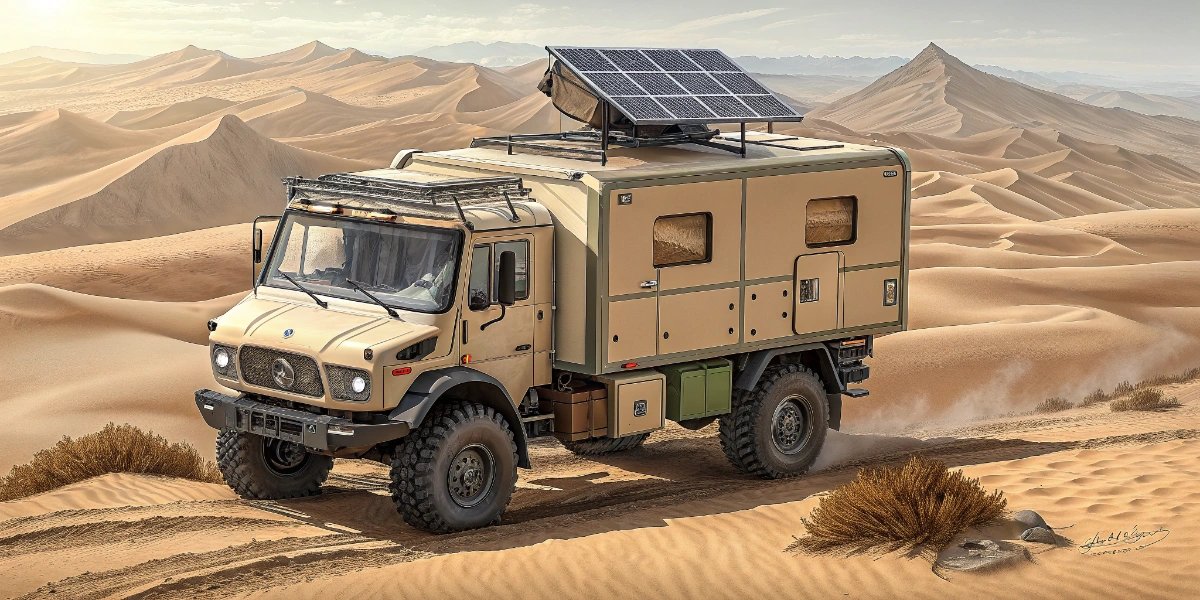
Overlander trucks are heavily modified off-road vehicles designed for self-sufficient transcontinental travel—crossing Sahara, Siberia, Pan-American Highway, Australian Outback without external support. Built on 4x4 military or commercial truck chassis (Unimog, MAN, Iveco) with custom-built expedition camper bodies. Equipped with: off-road tires and suspension, onboard water tanks (50-100+ gallons), solar panels and batteries, satellite communications, recovery equipment (winches, sand ladders, air compressors), spare parts, and living quarters with kitchen/bed/bathroom. Designed for months-long journeys through areas with no services—fuel range 600+ miles between refills, food storage for weeks, and mechanical simplicity enabling field repairs.
Why It Matters
Self-sufficiency philosophy: Overlanders don't rely on infrastructure—they carry everything needed: fuel, water, food, shelter, tools, spare parts. This independence enables traveling anywhere roads exist (and many places roads don't) without depending on hotels, restaurants, or mechanics. It's intentional rejection of convenience dependence: accepting heavy vehicle, reduced performance, and significant cost for freedom to go anywhere anytime. This appeals to people valuing independence over comfort—willing to trade easy living for exploration freedom. It's statement about priorities: adventure matters more than convenience.
Extreme terrain capability: Overlanders handle terrain regular 4x4s can't: deep sand (aired-down tires, sand ladders for extraction), mud (locking differentials, high clearance), water crossings (snorkels, waterproofed electronics), steep rocky trails (low-range gearing, armor plating protecting undercarriage), and snow/ice (heavy vehicle with excellent traction). This capability enables accessing places that stop normal vehicles: remote deserts, mountain passes, jungle tracks, Arctic tundra. Capability is expensive (modifications cost $100,000+) but makes impossible routes possible. It's purchasing freedom through engineering.
Community and knowledge sharing: Overlanding community shares route information, mechanical advice, border crossing tips, and remote hazard warnings through websites, forums, and apps (iOverlander). This knowledge-sharing is essential: mistakes in remote areas can be fatal, and learning from others' experiences prevents repeating dangerous errors. Community also provides informal rescue network: overlanders help each other with breakdowns, supply sharing, and mechanical expertise. This cooperation shows that extreme adventure benefits from community, not just individual self-reliance. Independence is enabled by cooperative knowledge sharing—seeming paradox that actually makes sense.
Cultural Significance
Overlander trucks represent rejection of conventional tourism: flying to resorts, staying in hotels, following tour groups. Overlanders prefer slow overland travel, camping wild, cooking own food, and accepting discomfort as price of authenticity. This philosophy appeals to people feeling modern life is too sanitized—seeking "real" experiences unmediated by tourism industry. Whether this is genuine authenticity or privileged adventure tourism depends on perspective—but overlanders believe they're engaging with world more directly than conventional tourists. Vehicles enable this philosophy: purpose-built tools for alternative travel vision.
Fun Facts
- Popular base vehicles: Mercedes Unimog, MAN TGM, Iveco Daily 4x4—tough commercial/military trucks
- Total cost: $150,000-500,000 depending on base vehicle and modifications—expensive adventure
- Fuel range: 600-1,000 miles common—essential when fuel stations are 500+ miles apart
- Expeditions last months/years—some people quit jobs, sell houses, travel full-time for 2-5 years
- Popular routes: Pan-American Highway (Alaska→Argentina), Trans-Africa (Cairo→Cape Town), Silk Road (Turkey→China)
- Border crossings are adventure: carnets (vehicle passports), bribes, bureaucracy, and patience required
Teaching Moment
Overlander trucks teach about self-sufficiency, independence trade-offs, and alternative lifestyles. Kids learn that some people choose difficult experiences: overlanders accept heavy vehicles, slow speeds, and discomfort for exploration freedom. Understanding that different people value different things—some prioritize comfort, others prioritize adventure—builds tolerance for lifestyle diversity. Also demonstrates that independence requires preparation: carrying spare parts, tools, and supplies seems excessive until breakdown happens 500 miles from help. Finally, teaches about community and knowledge-sharing: even independent adventurers depend on others' experience and help. True independence is rare—usually we're interdependent, relying on community in different ways.
5. Amphibious Vehicle (DUKW "Duck") - Land AND Water Capability
What It Is
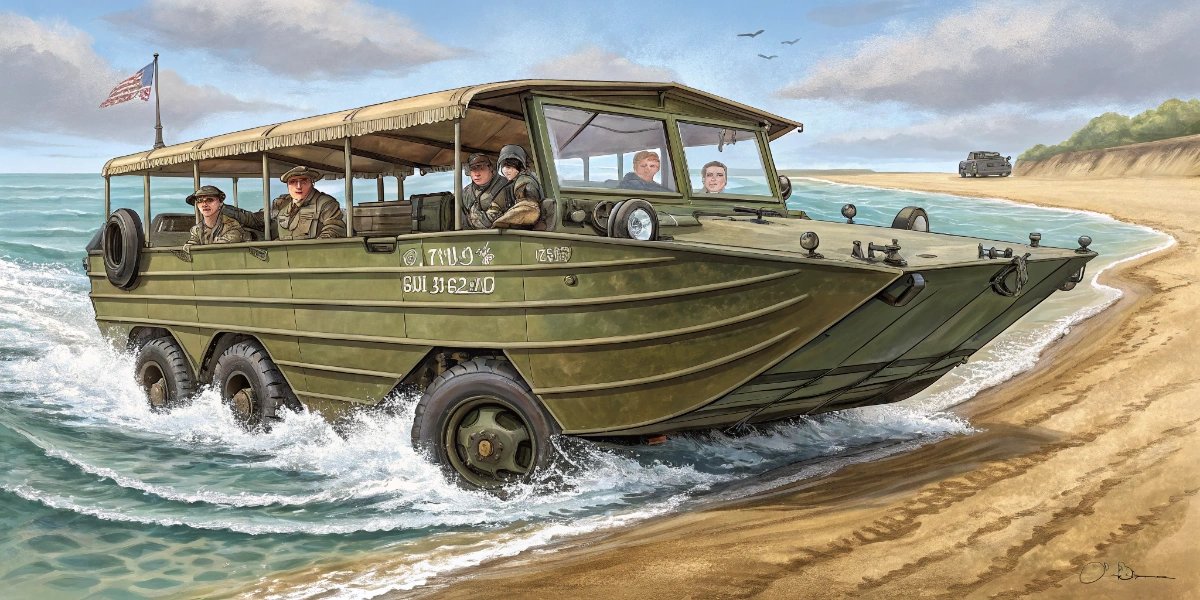
The DUKW (pronounced "duck") is amphibious six-wheel-drive truck developed during WWII (1942) for beach landings—driving from ship to shore without docks. Still used today for tourist "duck tours" in some cities and for certain emergency applications. Boat-shaped hull made watertight, six-wheel drive on land, propeller for water propulsion, and bilge pumps removing water that seeps in. Transitions from land to water by driving directly into water—no ramp or dock needed. Drives on roads at highway speeds, motors through water more slowly, and carries large groups of passengers or cargo.
Why It Matters
Dual-mode engineering complexity: Designing vehicle that works both on land AND water requires compromises: boat hull shape reduces land aerodynamics (wastes fuel), heavy waterproofing adds weight (reduces payload), propeller/rudder add drag on land, and six-wheel drive is overkill on pavement but necessary for soft beach sand. DUKW is neither best truck nor best boat—it's decent at both, accepting compromises for versatility. This trade-off illustrates engineering principle: optimizing for two different requirements means being perfect at neither. Amphibious vehicles are valuable when versatility matters more than peak performance in single environment.
WWII innovation still relevant decades later: DUKW was emergency wartime design, yet versions of the design remain useful today—testament to solving problem well enough that better solutions haven't completely replaced it. Military retired original DUKWs decades ago (replaced by newer amphibious vehicles), but tourist industry still uses similar concepts because they work: reliable, maintainable, and unique. This longevity shows that sometimes "good enough" solutions last for generations if they meet needs adequately. Cutting-edge isn't always necessary—proven designs have value.
Tourist attraction enabling water-land tours: Duck-style tours leverage amphibious capability for unique tourism: driving through city streets narrating sights, then splashing into harbor/river continuing tour on water without passengers leaving vehicle. This seamless transition is entertainment and convenience—tourists pay premium for novelty. DUKW-style vehicles found second life as tourist vehicles after military retirement, showing how specialized equipment can pivot to new purposes when original mission ends.
Cultural Significance
DUKWs represent WWII American industrial capacity—designing, building, and deploying tens of thousands of specialized vehicles in a few years. This rapid innovation and mass production characterized American war effort: identifying needs, engineering solutions quickly, manufacturing at scale. They also symbolize military technology becoming civilian: trucks designed for war repurposed for tourism. This transformation—equipment designed for conflict becoming tools for recreation—reflects peaceful repurposing of military surplus.
Fun Facts
- Name "DUKW" is manufacturer's code: D=1942, U=Utility, K=all-wheel drive, W=dual rear axles
- Thousands were built during WWII—massive production for specialized vehicle
- Some cities still operate duck-style tours using modern amphibious vehicles inspired by original DUKWs
- Amphibious vehicles must meet safety standards for both road and water operation—complex regulations
- Some variants were used for disaster relief—bringing supplies to flooded areas unreachable by normal trucks
Teaching Moment
Amphibious vehicles teach about engineering trade-offs, versatility vs specialization, and adaptive reuse. Kids learn that vehicles designed for one purpose (military beach landings) can find completely different uses (tourist entertainment, disaster relief). This adaptability shows that solutions to old problems can solve new problems unexpectedly. Also demonstrates compromise: amphibious vehicles aren't best trucks or best boats, but being adequate at both has value when you need both capabilities. Understanding trade-offs—that optimizing for versatility means not being perfect at anything—is important life lesson applicable beyond vehicles.
6. Baja Racing Trophy Truck - Desert Racing Extreme
What It Is
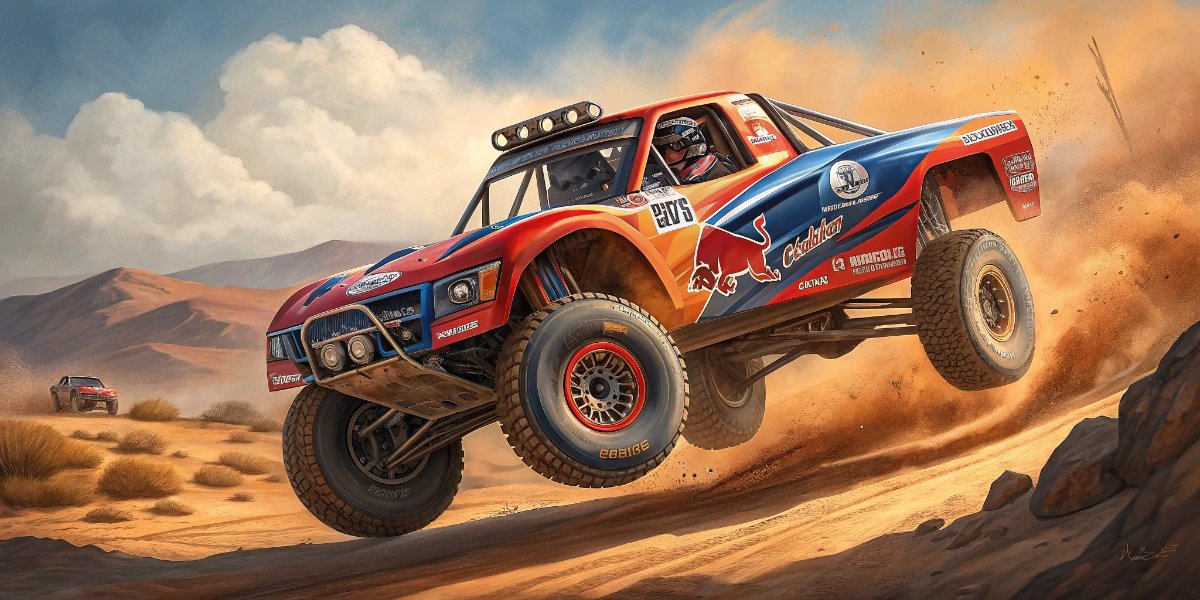
Trophy trucks are custom-built unlimited-class off-road racing trucks competing in Baja 1000 and similar desert races. Purpose-built race machines (not modified production trucks), they feature: 900+ horsepower engines, 30+ inches suspension travel (wheels move up/down 2.5 feet), lightweight but strong bodies, huge off-road tires, and race-ready everything (brakes, transmission, cooling, safety). Cost hundreds of thousands of dollars to build, reach very high speeds across desert, and regularly jump dozens of feet through air. They're purpose-built for single mission: winning desert races by going faster than physically seems possible over brutal terrain.
Why It Matters
Suspension travel enabling high-speed rough terrain: Enormous wheel travel means truck can hit obstacles at speed without jarring occupants—suspension absorbs impacts that would destroy normal trucks. This allows: maintaining very high speeds over washboard terrain (undulating dirt), jumping rocks/ravines at speed (suspension compresses on landing), and racing through darkness trusting suspension to handle unseen obstacles. Without extreme suspension travel, trophy trucks would need to slow down for every bump—losing races. Suspension is key differentiator: stock trucks have much less travel; trophy trucks have three times more. Triple the suspension travel enables dramatically higher safe speeds over same terrain.
Endurance challenge: Races like the Baja 1000 are 1,000+ mile off-road events taking many hours of continuous driving. Trophy trucks must combine mechanical reliability (vehicles must finish, not just start), driver endurance (racing long hours straight), team coordination (pit stops for fuel/repairs), and navigation (finding correct route through remote desert). It's not just vehicle capability—it's complete system (truck + driver + team + preparation) all functioning under extreme stress. Winning requires everything working together.
Spectacle and danger appeal: Trophy truck racing is spectacle: powerful trucks flying through air, crashing in spectacular ways (often drivers walk away thanks to safety equipment), and racing through towns with spectators standing close. This danger attracts fans—motorsport appeal includes risk. People watch because it's exciting to see humans and machines pushed near limits. Safety equipment has improved dramatically, but possibility of crashes remains—part of motorsport reality.
Cultural Significance
Trophy trucks represent American and Mexican desert racing culture: bigger, louder, more extreme than necessary. Where some racing focuses on precision and others on handling, desert racing emphasizes power and durability—conquering brutal terrain through engineering excess. It's culturally specific: Baja's geography and proximity to communities of builders and racers create racing culture that wouldn't exist everywhere. Trophy trucks also represent privateer racing: many teams are individuals or small groups, not giant corporations. It's expensive hobby but built around personal passion for engineering and adventure.
Fun Facts
- Some trophy trucks exceed 900 horsepower—more than many race cars used on paved tracks
- Huge off-road tires are often replaced after a single big race—they wear quickly at racing speeds
- Trucks are designed to spend time in air—suspension geometry anticipates landings from jumps
- Endurance races require multiple drivers—teams swap drivers during pit stops for safety
- Night racing uses powerful light bars—turning dark desert into daylight directly in front of truck
Teaching Moment
Trophy trucks teach about specialization, engineering for single purpose, and risk/reward decisions. Kids learn that some vehicles are built for one thing only: winning races. This extreme specialization (opposite of versatile overlanders) shows focus achieves excellence—if you optimize for one goal, you can achieve exceptional performance that generalist vehicles can't match. Also demonstrates that speed costs money: complex race vehicles that wear out expensive parts quickly show how high performance requires big investments. Finally, raises questions about risk: races are thrilling because they carry danger. Talking about safety equipment, driver training, and informed risk helps kids think about balancing excitement with safety.
7. NASA Crawler-Transporter - World's Largest Tracked Vehicle
What It Is
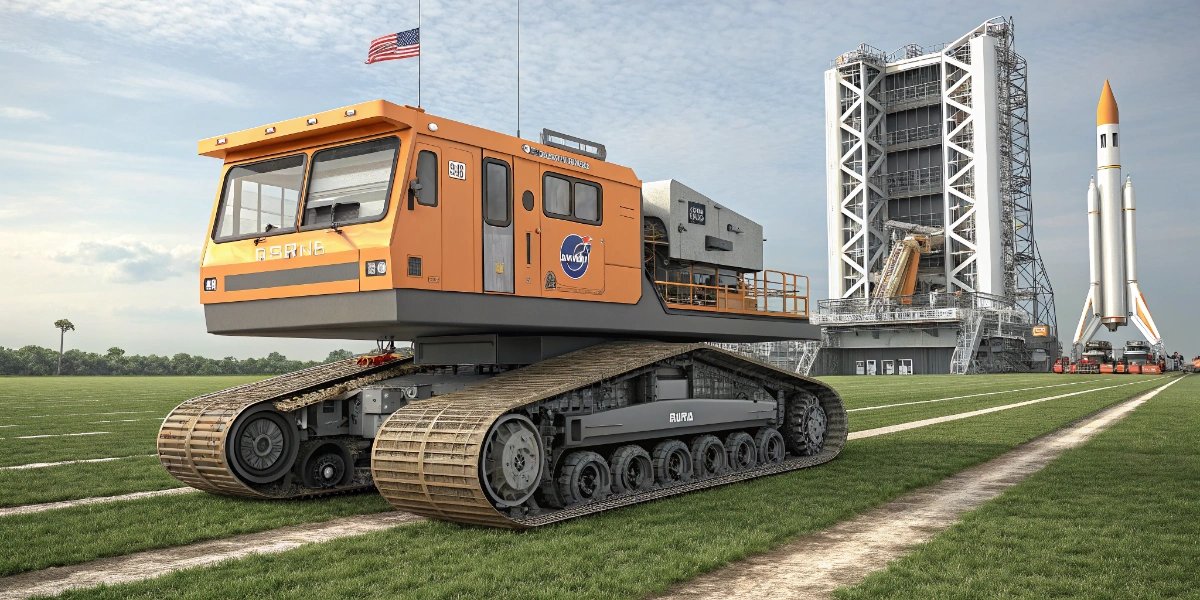
NASA's Crawler-Transporter is among the largest tracked vehicles on Earth, built in the 1960s to transport Saturn V rockets from Vehicle Assembly Building to launch pads at Kennedy Space Center—a several-mile journey taking many hours at walking speed. Two crawlers exist (both still operational after decades). Each weighs millions of pounds, measures longer and wider than many buildings, and rides on eight tank-style tracks. Powered by large diesel engines driving generators, crawlers move rockets and launch platforms as single massive assemblies.
Why It Matters
Engineering for extreme weight: Transporting rockets weighing tens of millions of pounds requires unique engineering: multiple independent track systems distributing weight so ground pressure stays low (preventing sinking into soil), hydraulic leveling keeping platform perfectly level (rocket must remain vertical during transport), steering system coordinating many motors, and specially constructed roadways supporting huge loads. Normal vehicles couldn't carry this weight without sinking or collapsing—crawler is specialized machine solving problem nothing else can.
Extreme slowness as safety feature: Maximum speed around 1 mph with rocket loaded (a little faster unloaded) seems absurdly slow but is intentional safety: rockets are fragile despite size (thin metal skins, full of fuel, stacked vertically creating tall structures), any sudden movement could damage or topple rocket (destroying extremely expensive hardware). Slow speed allows constant monitoring (engineers walk alongside watching for problems). Speed isn't goal—safe transport is. Crawlers could physically move faster but deliberate slowness ensures rocket arrives undamaged.
Long-term infrastructure and durability: Crawlers built in 1960s still operate today—testament to over-engineering and excellent maintenance. They've transported Saturn V (Apollo), Space Shuttle, and now newer rockets—serving multiple space programs across six decades. This longevity came from building extremely robust machines, maintaining them carefully, and upgrading components as needed. Infrastructure that lasts 50+ years requires upfront investment but saves money over time by avoiding frequent replacement.
Cultural Significance
Crawlers represent peak of early American space program ambition: building enormous infrastructure at massive scale, over-engineering for reliability because space missions couldn't tolerate failure. They also symbolize continuity: while rockets changed, crawlers remained constant—literally carrying each generation of spacecraft. They're living history—machines that transported vehicles for Moon missions still working today.
Fun Facts
- Fuel consumption is enormous—hundreds of gallons of diesel per mile
- Ground pressure under crawler tracks is lower than human footprint—preventing roadway damage despite enormous weight
- Crawlers can "crab steer"—moving diagonally or turning in place despite huge size
- Operators sit in control cabs on opposite corners—coordinating steering and speed precisely
- Upgrades over decades increased carrying capacity to handle newer, heavier rockets
Teaching Moment
NASA crawlers teach about engineering scale, durability, and intentional slowness. Kids learn that biggest doesn't mean fastest—crawlers are among the largest tracked vehicles but also some of the slowest by design. Understanding that speed isn't always goal shows situational thinking: sometimes slow is optimal. Also demonstrates long-term infrastructure value: machines built decades ago still doing essential work today. Building durable infrastructure costs more upfront but saves money over decades. Finally, teaches about over-engineering benefits: designing systems stronger than necessary can enable future uses not imagined at original design time.
8. Snowcat Polar Explorer - Research Support Vehicle
What It Is
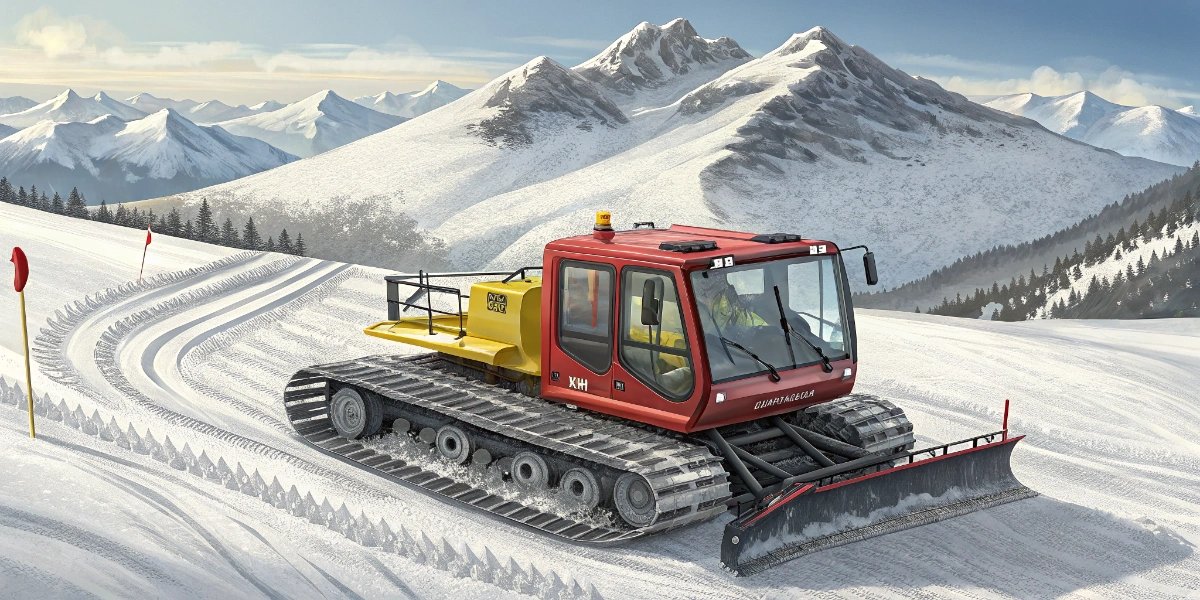
Snowcats are tracked vehicles designed for deep snow operations—research support in polar regions, ski slope grooming, polar traverses, and mountain rescue. Unlike road vehicles with wheels, snowcats use wide tracks distributing weight over large area (preventing sinking into soft snow). Modern research snowcats are enclosed heated cabins carrying crews and cargo, equipped with survival gear, satellite communications, and specialized towing equipment. Some research snowcats tow supply sleds on long polar journeys, others support scientific stations, and some groom ski slopes creating smooth surfaces for skiers.
Why It Matters
Weight distribution preventing sinking: Soft snow (powder, fresh snowfall, windblown drifts) won't support concentrated weight—wheeled vehicles sink and become stuck. Snowcat tracks distribute vehicle weight over large contact area vs wheels concentrating weight on small patches—reducing ground pressure and preventing sinking. This physics principle (pressure = force/area) enables travel across snow that would trap regular vehicles. It's same principle snowshoes use: spreading weight across larger area. Tracks work where wheels fail—demonstrating that vehicle design must match terrain.
Ski slope grooming essential to industry: Ski resorts depend on snowcats grooming slopes nightly—creating smooth corduroy surface skiers expect. Without grooming, snow becomes bumpy, icy, and dangerous for novice skiers. Snowcats work overnight tilling snow with rear-mounted tiller (rotary blade pulverizing ice/bumps), flattening with drag behind tiller, and creating groomed surface. This transformation happens nightly—most skiers never see grooming operations but benefit every run. Snowcats are invisible infrastructure enabling winter recreation.
Polar research traverse vehicles: Antarctic research requires transcontinental travel: moving scientists and equipment between coastal stations and remote inland camps. Snowcats towing supply sleds complete these journeys—thousands of miles round trip taking months, crossing featureless ice plateaus, operating in extreme cold, and providing mobile shelter. These traverses collect ice core samples, deploy sensors, and maintain research stations. Without snowcats, inland Antarctic research would be impossible—helicopters lack range for some routes, planes can't land most places, and humans can't walk such distances in those conditions.
Cultural Significance
Snowcats represent specialized vehicles solving specific problems excellently—neither trying to be all-purpose nor cutting costs. They're expensive but worth it to industries and programs depending on them. This specialization shows that some problems justify purpose-built solutions rather than adapting general vehicles. Ski industry prioritizes snow grooming (customer experience depends on it), polar programs prioritize reliable transport (safety depends on it), and both pay premium for vehicles optimized for their needs.
Fun Facts
- Ski resort snowcats can cost hundreds of thousands of dollars—expensive but essential infrastructure
- Grooming takes hours nightly—covering entire ski resort before morning opening
- Polar traverses can be multi-month expeditions across continents of ice
- Track width determines flotation—wider tracks = less ground pressure = travel over softer snow
- Some snowcats have tilting cabs—rotating on steep slopes keeping operators level
- Maintenance is constant—extreme cold and heavy use require frequent servicing
Teaching Moment
Snowcats teach about weight distribution physics, specialization value, and invisible infrastructure. Kids learn that vehicle design must match terrain: wheels work on hard surfaces, tracks work on soft snow—right tool for right job. Also demonstrates weight distribution principle: spreading force over larger area reduces pressure and prevents sinking. Finally, teaches about invisible infrastructure: many systems people enjoy daily depend on behind-the-scenes work by specialized equipment.
What These Vehicles Reveal About Extreme Engineering
Solving Problems That Shouldn't Be Solvable
Extreme vehicles tackle challenges that initially seem impossible: driving on Moon (no air, extreme temperatures, 1/6th gravity), operating 140 million miles from Earth with 20-minute communication delays (Mars rovers), surviving -100°F where metal shatters (Antarctic), or carrying rockets weighing tens of millions of pounds at walking speed (NASA crawler). Engineers face these "impossible" problems and solve them through: specialized materials (titanium for space, arctic lubricants for cold), redundant systems (backups for everything critical), innovative design (tracks for snow, autonomous software for Mars), and accepting extreme costs. Extreme vehicles prove that "impossible" often means "very difficult and expensive"—not actually impossible.
Trade-offs Between Specialization and Versatility
Extreme vehicles show specialization spectrum: trophy trucks optimize for single purpose (winning desert races), amphibious DUKWs compromise to handle two environments (land + water), and overlanders balance capability with livability (go anywhere while providing comfortable home). Each approach has costs: specialized vehicles excel at one thing but fail at others, versatile vehicles are adequate at multiple things but excellent at none, and balanced vehicles cost more and weigh more. Understanding these trade-offs shows that engineering is constant balancing act—optimizing for competing requirements means compromising.
Extreme Costs Enabling Extreme Capability
Extreme vehicles are expensive: Mars rovers, NASA crawlers, trophy trucks, overlanders, and Antarctic vehicles all cost far more than everyday vehicles. These costs buy capability impossible at lower budgets: Mars rovers last many years autonomously operating millions of miles away, crawlers transport rockets safely for decades, trophy trucks win races through engineering excess. Cost isn't waste—it's investment in capability. Sometimes expensive is only option: you can't Mars-rover cheaply, you can't Antarctic-vehicle on budget, you can't trophy-truck affordably. Extreme missions justify extreme costs.
Human Exploration Drive Despite Dangers
Extreme vehicles enable humans to reach places we shouldn't survive: Moon, Mars (via robots extending our reach), Antarctic interior, remote deserts, deep wilderness. This exploration drive—going places just to see what's there—is distinctly human. We could stay safe, warm, comfortable—but some people choose danger, discomfort, and expense to explore. Extreme vehicles are tools enabling this choice: lunar rovers let astronauts explore Moon miles from landing site, overlanders let adventurers cross deserts, Antarctic snowcats let scientists collect ice cores far inland. Engineering serves exploration instinct—building machines that push human reach beyond biological limits.
Learning Opportunities for Kids
Engineering Problem-Solving
Extreme vehicles teach systematic problem-solving: identify challenge, understand constraints, brainstorm solutions, test prototypes, and iterate until working. Kids learn that engineering isn't magic—it's methodical solving of problems through understanding physics and materials, thinking creatively about solutions, testing ideas, accepting failure as learning, and persisting until success.
Physics Concepts Made Visible
Extreme vehicles demonstrate physics principles: 1/6th gravity affecting lunar rover handling, weight distribution preventing snowcats from sinking, suspension travel absorbing trophy truck impacts, thermal management preventing Mars rover freezing, and pressure = force/area relationship enabling crawlers to carry enormous weight without damaging ground. These aren't abstract equations—they're practical applications visible in vehicle designs.
Trade-offs and Compromise
Extreme vehicles reveal that engineering means choosing: amphibious vehicles sacrifice land performance for water capability, trophy trucks sacrifice comfort for speed, overlanders sacrifice performance for self-sufficiency. Kids learn that optimizing for one goal often means compromising others—you can't have everything simultaneously. This understanding—that choices involve trade-offs—applies beyond vehicles.
Persistence and Long-Term Thinking
Crawlers operating for decades, Mars rovers lasting far beyond design life, and overlander expeditions taking months demonstrate patience and long-term commitment. Kids learn that some achievements require sustained effort: you can't Mars-rover quickly, you can't cross deserts hastily, you can't build decades-long infrastructure cheaply. These accomplishments require planning carefully upfront, accepting slow progress, maintaining consistently, and thinking years ahead.
Discussion Questions for Parents and Kids
- Would you rather drive a lunar rover on Moon or Mars rover on Mars? What makes each challenging?
- Why do trophy trucks cost so much money if they're just for racing?
- If you could take an overlander expedition anywhere, where would you go? What would you need to bring?
- Should we spend billions of dollars on Mars rovers, or use that money differently? What's more valuable: space exploration or other priorities?
- Why are NASA crawlers so slow? Would faster be better or worse?
- If amphibious vehicles aren't best trucks or best boats, why build them? When is "adequate at two things" better than "excellent at one thing"?
- What extreme place would you want to explore? What vehicle would you need to get there safely?
Explore More Extreme Environments
These extreme vehicles operate in Earth's harshest conditions and beyond. Compare to other challenging environments:
- Greenland & Iceland - Arctic survival engineering
- Dubai & Gulf States - Extreme heat and wealth
- Australia - Outback isolation and road trains
See complete overview at World Vehicles for Kids: Complete Guide.
App Connection: Learning Through Extremes
In Talk & Listen, children learn vehicle names including trucks, rovers, and specialized machines. Understanding extreme vehicles teaches that same vehicle category (truck, rover) can mean vastly different things based on environment and purpose—pickup truck vs overlander vs trophy truck vs Antarctic truck are all "trucks" but designed for completely different challenges.
To connect this article directly to hands-on exploration, you can also visit these Little Wheels vehicle pages and resources:
- Wander Wheels adventure vehicles – hub page for ATVs, campers, safari cars and other adventure vehicles
- Wander Wheels Coloring Book – free adventure vehicle coloring book when you need calm time
- Moon Buggy – kid-friendly overview of lunar rover vehicles
- Mars Rover – exploring how robots drive on another planet
- Overlander – turning a truck into self-sufficient expedition home
- Amphibious Vehicle – land vehicles that can also move through water
- Polar Explorer – adventure vehicle designed for ice and snow
These connections help children see that the same core ideas—traction, temperature, distance, fuel, safety—show up in both everyday vehicles and extreme machines.
Explore More Vehicle Types
Extreme adventure vehicles represent engineering at its limits. Compare to other specialized vehicle categories:
- Racing Vehicles Around the World – NASCAR, Formula One, rally cars, and dragsters pushing speed limits
- American Cars Through History – How vehicles evolved from horse buggies to muscle cars over 100 years
 Frequently Asked Questions
 Ad-free & offline ready