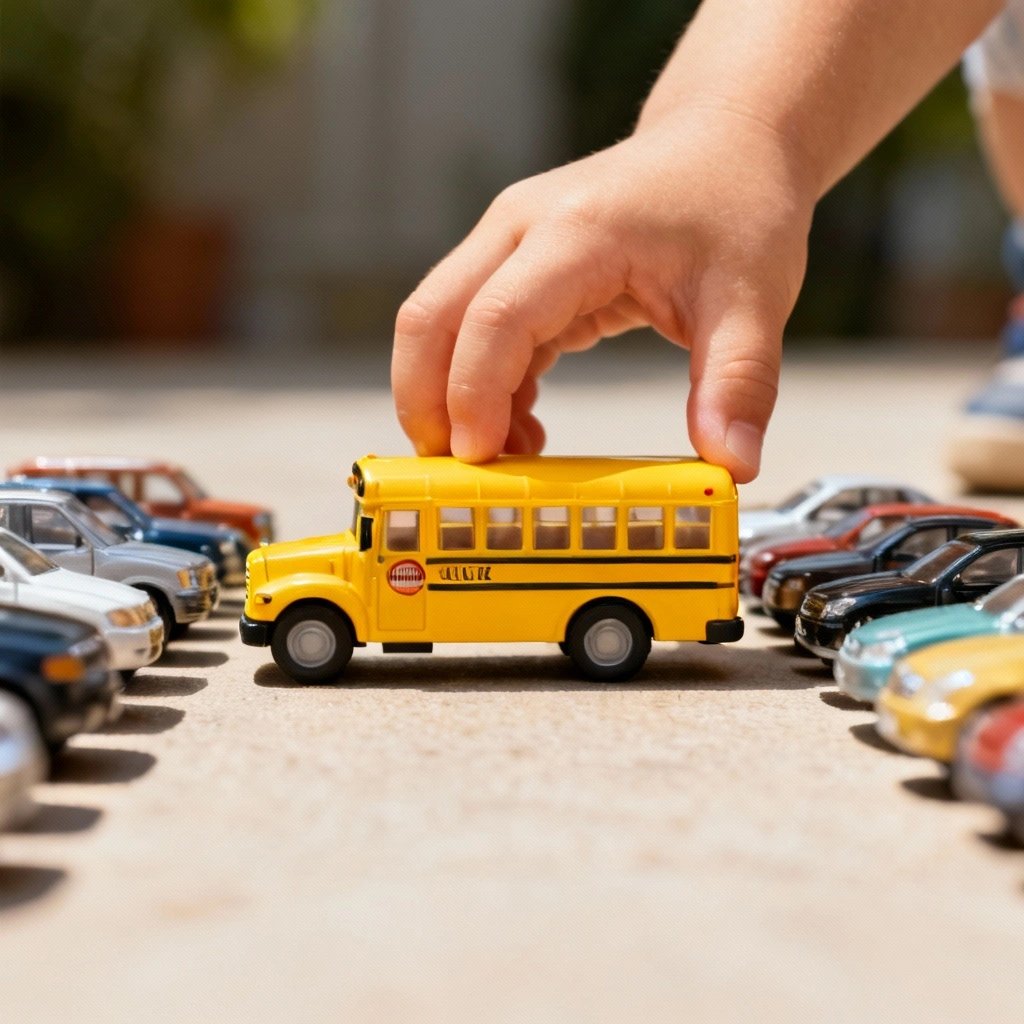
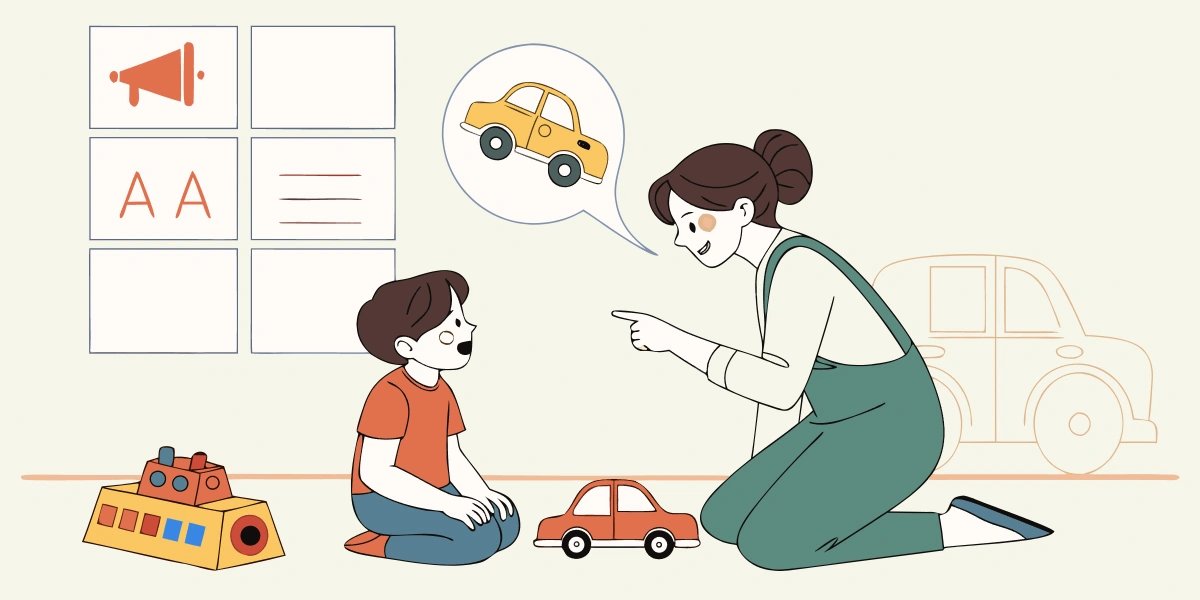
Hand a toddler a toy fire truck and watch what happens. Before they've said "truck" or "red" or even "go," they'll make the sound: "Nee-naw! Nee-naw!" Or maybe "Vroom!" if it's a car. "Choo-choo!" for a train.
Vroom Definition
What does vroom mean?
Vroom (noun/verb): An onomatopoeia that imitates the sound of an engine revving or a vehicle moving. Pronounced /vruːm/. Used to represent the roaring, rumbling sound made by cars, trucks, motorcycles, and other motorized vehicles.
Example: "The race car went vroom around the track." • "I heard the vroom of the motorcycle."
Is vroom an onomatopoeia?
Yes. "Vroom" is an onomatopoeia—a word that phonetically imitates the sound it describes. Like "buzz," "splash," and "bang," vroom belongs to a special category of words where the sound directly represents the meaning. This makes vroom and other sound words especially valuable for toddler speech development.
Quick examples parents can use
- Car: vroom • Train: choo‑choo • Fire truck: nee‑naw
- Horn: beep‑beep • Crash: bang • Water: splash
- Pair it: name → sound → action. “Car. Vroom! Car goes fast.”
What is vroom in grammar?
An onomatopoeia—a word that imitates sound. Kids learn these faster because the sound maps to meaning.
Is vroom a real word?
Yes. Dictionaries list “vroom” as a verb/noun for engine sound. It’s great for early speech practice.
These aren't just cute sound effects—they're linguistic gold. Onomatopoeia (words that imitate sounds) represents one of the most powerful entry points into language for young children, and the research on why this works is fascinating.
If your toddler is a late talker, focusing on sound words might be one of the smartest strategies you can use. Here's what the science tells us.
What Makes Onomatopoeia Special?
Most words in language are arbitrary. There's no inherent reason why "dog" means dog—it's just a convention we've all agreed upon. Children have to memorize these connections between sound and meaning, which requires significant cognitive work.
But onomatopoeia is different. The word sounds like what it means. "Splash" actually sounds splashy. "Buzz" mimics the sound of bees. "Vroom" captures engine noise.
This direct sound-meaning connection—what linguists call iconicity—makes these words dramatically easier for children to learn and remember.
A 2021 study in Cognitive Science found that 18-month-olds learned sound-symbolic words significantly faster than arbitrary words, even when both were paired with the same object. The sound itself provided an extra memory hook that arbitrary words lacked.
The Phonological Advantage
There's another reason onomatopoeia works so well: the sounds themselves are often easier to produce.
Early speech sounds include:
- Bilabials: /b/, /m/, /p/ (formed with two lips)
- Vowels: /a/, /o/, /u/ (the first vowels babies babble)
- Nasals: /m/, /n/ (air flows through the nose)
- Glides: /w/ (transitions between sounds)
Now look at common onomatopoeia:
- "Moo" = /m/ + /u/ (both early sounds)
- "Baa" = /b/ + /a/ (both early sounds)
- "Vroom" = /v/ + /r/ + /u/ + /m/ (mostly easy sounds)
- "Beep" = /b/ + /i/ + /p/ (all accessible)
Vehicle sounds, in particular, tend to use phonemes that emerge early in development. A child who can't yet say "ambulance" can absolutely say "nee-naw." A child who struggles with "garbage truck" can manage "vroom-vroom."
This phonological match between sound words and early speech abilities isn't accidental—it's why parents across cultures naturally use onomatopoeia when talking to babies. We're instinctively giving them words they can actually produce.
The Multisensory Memory Boost
When a toddler learns the word "vroom," they're not just processing auditory information. They're integrating:
- The sound of the engine (auditory)
- The sight of the moving vehicle (visual)
- The feeling of motion, if they're holding the toy (kinesthetic)
- The motor action of making the sound themselves (proprioceptive)
This multisensory encoding creates stronger neural connections than single-pathway learning. Research on memory formation consistently shows that the more senses involved in learning something, the better we remember it.
A 2022 study published in Developmental Psychology demonstrated that children who learned new words through iconic (sound-matching) presentation showed better retention at one-week follow-up compared to children who learned the same words through arbitrary presentation.
Translation for parents: When your child says "choo-choo" while pushing a train, their brain is building a robust, multi-layered understanding of trains, movement, sound, and communication all at once.
Cross-Cultural Evidence
If onomatopoeia were just a quirky feature of English baby talk, we might question its importance. But sound-symbolic words appear in every language studied, and many cultures embrace them far more extensively than English speakers do.
Japanese, for example, has thousands of onomatopoetic expressions that adults use regularly in formal contexts. Korean similarly has a rich system of sound-symbolic words. Research comparing vocabulary development across languages finds that children learning languages with more onomatopoeia often show slightly faster early word acquisition.
A 2023 study in the Journal of Child Language analyzed infant-directed speech in 12 languages and found that caregivers universally increased their use of sound-symbolic words when talking to prelinguistic babies. This cross-cultural consistency suggests we're tapping into something fundamental about how human brains learn language.
From Sound Effects to Sentences
One concern parents sometimes raise: "If my child only makes vehicle sounds, will they ever learn real words?"
The research here is reassuring. Onomatopoeia doesn't replace conventional vocabulary—it scaffolds it.
Here's how the progression typically unfolds:
- Sound alone: "Vroom!" (15-18 months)
- Sound + gesture: "Vroom!" while pointing at car (18-20 months)
- Sound becomes label: "Vroom" used consistently to mean "car" (20-24 months)
- Conventional word emerges: "Car!" alongside or replacing "vroom" (24-30 months)
- Word combinations: "Big car!" or "Car go!" (30-36 months)
Each stage builds on the previous one. The sound word isn't a detour—it's the foundation.
And here's something interesting: Many children keep using sound words alongside conventional vocabulary for years, often in creative ways. A three-year-old might say "The vroom-vroom car goes beep-beep!" combining onomatopoeia with real words in increasingly complex sentences.
Vehicle Sounds as Speech Practice
This is why we structured Talk & Listen around vehicle sounds. It's not just about cars and trucks (though toddlers do love those)—it's about leveraging the unique linguistic properties of sound-symbolic words.
When a child taps the fire truck card and hears "nee-naw," they're getting:
- A sound pattern they can actually produce
- A clear connection between sound and object
- An opportunity to practice breath control and phoneme sequencing
- Intrinsic motivation to repeat and explore
The long-press feature takes this further: hearing the sound stretched out—"neeeee-nawwww"—helps children parse the individual phonemes and practice sustained vocalization. These are foundational skills for all speech development.
And because vehicles are nearly universal objects of fascination for young children, we're working with their natural interests rather than against them. A child who won't sit still for flashcard drills will happily make vehicle sounds for 20 minutes straight.

Practical Strategies for Parents
You don't need an app to use onomatopoeia effectively (though it helps!). Here are some evidence-based strategies:
Narrate with sound effects
"The dog says woof! The cat says meow!" Pair animal names with their sounds consistently.
Exaggerate prosody
Make your sound words extra expressive: "VROOOOM!" with rising intonation encourages imitation more than flat "vroom."
Create sound-action pairings
"Splash!" when water hits the tub. "Crash!" when blocks fall. "Zoom!" when a ball rolls. Connect sounds to experiences.
Accept approximations
If your child says "buh-buh" for "beep-beep," celebrate it! They're attempting the structure even if the sounds aren't perfect yet.
Build from interests
If your child is obsessed with trains, milk those train sounds for all they're worth. "Choo-choo!" can lead to "train," then "big train," then "The train goes fast!"
Free Speech Practice Cards
Download our free vehicle sound cards for speech practice at home. Perfect for late talkers and toddlers building vocabulary.
Get free printables →When to Add Conventional Words
Around age two, start deliberately pairing sound words with standard vocabulary: "That's right, vroom! It's a car. A red car goes vroom!"
Don't correct or replace—just expand. Your child says "moo-moo," you say "Yes, the cow says moo!" You're honoring their communication while modeling the next level.
Most children naturally transition to conventional vocabulary as their phonological skills develop. The sound words served their purpose: they got communication flowing.
The Bottom Line
Onomatopoeia isn't baby talk to outgrow—it's a linguistic bridge to cross. The sound-meaning connection, the phonological accessibility, the multisensory encoding: all of these make sound-symbolic words ideal for early speech development.
So when your toddler makes that "vroom" sound for the hundredth time today, know that they're not just playing. They're practicing breath control, phoneme production, sound-meaning mapping, and intentional communication.
They're learning to talk—one vehicle sound at a time.
Further Reading
- Talk & Listen App - Vehicle-based speech practice designed around onomatopoeia and early phonemes
- Late Talker App Guide: What Actually Works - Comprehensive comparison of speech development apps
- The Science Behind Vehicle-Based Learning - Why vehicles make such effective teaching tools for toddlers
 Frequently Asked Questions
 Ad-free & offline ready