How do vehicles help toddlers talk?
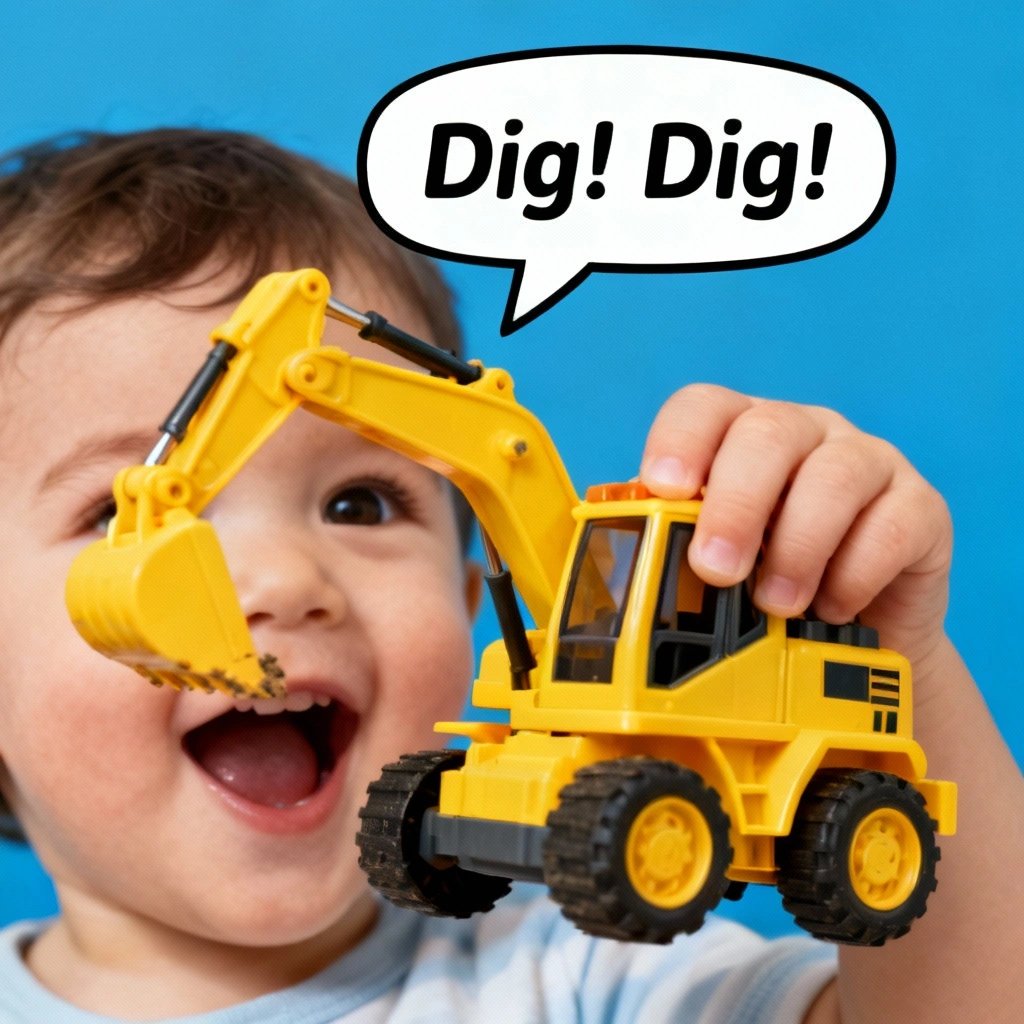
Vehicles captivate toddler attention, creating 'intense interests' that often make practice feel easier and more motivating. Their repetitive sounds (vroom, beep) act as easy-to-say 'bridge words,' while their movements teach core functional vocabulary like 'go,' 'stop,' 'up,' and 'down' naturally through play.
Your toddler can perfectly imitate a fire truck siren but struggles to say "mama"? You're not alone. Many kids learn and practice words more readily when the content matches an intense interest. If your child is vehicle-obsessed, you're holding a powerful speech development tool.
🛡️ For the "Wait and See" Worriers
Pediatricians often say "wait and see," but that can feel agonizing. You don't have to just wait. These activities are "low stakes, high engagement" interventions you can do today.
They align with evidence-based parent–child interaction strategies—like slowing down to observe, wait, and listen before you jump in—but require no formal training. A toy truck and your presence are enough to start.
This guide provides 27 specific vehicle speech activities organized by age and phoneme type. Each activity leverages your child's natural vehicle fascination to support language development.
🧭 Part of: 150+ Offline Vehicle Activities for Toddlers
🔗 Related:Fire TruckExcavatorGarbage Truck
Important Notice: This content is for educational purposes only and is not medical advice. If you have concerns about your child's speech development, consult your pediatrician or a speech-language pathologist for proper evaluation and guidance.
Quick Start: 5-Minute Setup
Different types: car, truck, train
Jump to your child's section below
Try Activity #1 first
Parent Tip: Don't force it. If they're not interested today, try again tomorrow. Speech development happens in bursts, not steady lines.
📋 What's Inside
Sound play, first words, "go/stop"
Two-word phrases, action verbs
Storytelling, problem-solving, questions
Download button below for clean PDF
✨ Print-optimized: Clean formatting with activity cards and troubleshooting tips
Ages 18-24 Months: Early Sound Play
At this age, toddlers are "sound scientists." They are experimenting with their mouth muscles and learning that specific sounds have meaning. Vehicles are perfect because they make distinct, repetitive noises that are often easier to say than words.
🔊 Activity 1: Vehicle Sound Imitation
Target Skills: Early consonant sounds (/b/, /m/, /v/, /w/), lip rounding, breath control
- •Sit on the floor with 3 different vehicles (e.g., fire truck, car, train).
- •Hold the fire truck near your mouth (but visible to the child).
- •Make a long, exaggerated sound: "WEE-ooo-WEE-ooo."
- •The Pause: Hand the truck to your child and wait. Count to 5 in your head.
- •If they make any sound, cheer! "Yes! WEE-OOO!"
If your child just stares or grabs the truck without making sounds, that's normal! Try: (1) Making the sound 3-4 times yourself first, (2) Using a more exciting vehicle (fire truck usually wins), (3) Trying again after a snack—hunger kills engagement.
Once they're making sounds consistently, add a second vehicle and alternate: "Your turn—fire truck! My turn—police car!" This builds turn-taking skills.
🚦 Activity 2: The "Go" and "Stop" Traffic Light
Target Skills: Core vocabulary, impulse control, anticipation
- •Hold a car at the top of a ramp (or couch cushion).
- •Say "Reaaaaaaaady.... Seeeeeeet...." (build the tension!).
- •Wait for eye contact.
- •Shout "GO!" and let it fly.
📦 Activity 3: The "Mystery Tunnel" Naming Game
Target Skills: Object labeling (nouns), object permanence
- •Use a cardboard box or blanket as a "tunnel."
- •Hide a vehicle inside.
- •Knock on the tunnel: "Knock, knock! Who is it?"
- •Slowly reveal the vehicle... "It's a... TRUCK!"
Ages 2-3 Years: Combining Words
Once your child has single words, the goal is to glue them together. Vehicles are excellent for "Pivot Phrases"—using one anchor word (Vehicle) with many different action words.
🔄 Activity 4: "Vehicle + Action" Combos
Target Skills: Two-word phrases (Agent + Action)
- •Don't just say "Truck." Describe what it's doing.
- •"Truck drive."
- •"Truck stop."
- •"Truck crash."
🏠 Activity 5: The "In and Out" Garage
Target Skills: Prepositions (spatial concepts)
- •Get a shoebox. Cut a door.
- •Drive the car IN. "Car goes IN."
- •Drive the car OUT. "Car comes OUT."
- •Put the car ON the box. "Car is ON the roof!"
🔍 Activity 6: Detailed Part Labeling
Target Skills: Specific vocabulary, /w/ and /l/ sounds
- •Stop looking at the whole vehicle and look at the parts.
- •"Look at the wheels. Round wheels. Wuh-wuh-wheels."
- •"Here is the ladder. Up, up, up the ladder."
Ages 3-4 Years: Storytelling & Problem Solving
Now we move to "Narrative Language"—the ability to tell a story with a beginning, middle, and end. This is a crucial pre-literacy skill.
😱 Activity 7: The "Oh No!" Game
Target Skills: Sequencing (First, Then), emotion words
- •Set up a simple problem. "Oh no! The truck is stuck in the mud (blanket)!"
- •Ask: "What should we do?"
- •Guide the narrative: "First, we need the tow truck. Then, we hook it up. Last, we pull!"
🤔 Activity 8: "What If?" Scenarios
Target Skills: Hypothetical thinking, complex grammar
- •"What if the fire truck ran out of water?"
- •"What if the school bus could fly?"
- •"What if the excavator had a spoon instead of a bucket?"
✅ How to Know It's Working
You don't need perfect words to see progress. Look for these signs:
Eye contact when you make sounds, turning toward you, pausing their play
Any vocalization counts—even if it's not the "right" sound
Handing you the toy again, saying "more," or gesturing
Copying your movements (even without sounds) shows engagement
Remember: Speech development isn't linear. Some weeks they'll say 10 new words. Other weeks, nothing. Both are normal.
Troubleshooting: "My Child Won't Play Along"
😶 The "Silent Observer"
Issue: Child plays silently and ignores your prompts.
Fix: Stop asking questions ("What's this?"). Instead, just sportscast. Narrate what you are doing. "I am pushing the blue car. Vroom." Take the pressure off.
😠 The "Takeover"
Issue: Child takes the toy away from you.
Fix: Get your own car. "This is Mommy's car. That is Your car." Parallel play (playing next to each other) is a valid stage of social development.
When Offline Practice Meets Digital Support
These offline activities build foundational speech skills. But if your child needs targeted phoneme practice or you're concerned about speech delays, digital tools can provide structured support.
How Talk & Listen Extends Offline Play
- ✓Structured Progression: 4-tier system from simple sounds to complex phonemes
- ✓100+ Vehicles: More variety than most toy collections
- ✓Professional Voice Modeling: Clear pronunciation for every sound
- ✓Works Offline: No internet needed after download
Quick Reference: Activities by Phoneme
| Target Sound | Best Vehicles | Practice Words |
|---|---|---|
| /b/ sound | Bus, Bulldozer | Beep, Big, Bus |
| /f/ sound | Fire truck, Forklift | Fire, Fast, Four |
| /v/ sound | Van, Vehicle | Vroom, Van, Very |
| /k/ sound | Car, Crane | Car, Can, Come |
| /g/ sound | Garbage truck, Go-kart | Go, Garbage, Big |
Practice These Sounds with Our Interactive Quiz!
Ready to practice the vehicle sounds from these activities? Try our Vehicle Sounds Quiz—perfect for reinforcing the speech practice you just learned!
Play Vehicle Sounds Quiz →Takes 2-3 minutes • 20+ vehicle sounds • Fun speech practice for kids
Use These Speech Activities With Vehicles, Printables & Apps
To really lock in new sounds and words, let your child bump into the same vehicles in different places: on the road, on paper, and in the apps you use on hard days.
- Visit the Vehicles hub: Turn fire trucks, excavators, and garbage trucks from this guide into real-world spotting games you can talk about on walks and car rides.
- Print vehicle coloring pages & checklists: Use simple printables at the table to repeat the same target words (go/stop, wash, dig) in a calmer setting.
- Use Talk & Listen: Turn these offline games into structured phoneme practice with slow-motion models and lots of repetition.
- Create in Create & Play: Let vehicle art time double as speech practice—name colors, patterns, and vehicle types while they paint and build.
Frequently Asked Questions
Why are vehicle sounds good for speech?
Vehicle sounds (vroom, beep, choo-choo) are 'symbolic sounds' or onomatopoeia. They bridge the gap between babbling and real words because they are fun, repetitive, and carry meaning without requiring complex articulation.
What vehicle words should I teach first?
Start with 'functional' words like Go, Stop, Up, Down, In, and Out. These 'power words' give your child control over play. Then move to nouns (Car, Truck) and simple descriptors (Big, Fast).
How do I use toy cars for speech therapy at home?
Use the 'Owl' method: Observe what they are doing, Wait for them to look at you, and Listen. Then join their play using the 3-step sequence: 1. Make the sound ('Vroom'), 2. Pause and wait, 3. Repeat or expand ('Car go vroom').
References
Alexander, J. M., Johnson, K. E., & Kelley, K. (2008). Longitudinal analysis of the relations between opportunities to learn about science and the development of interests related to science. Science Education, 96(5), 763-786.
American Speech-Language-Hearing Association. (2023). Speech sound disorders: Articulation and phonology. ASHA Practice Portal. Retrieved from www.asha.org

 Ad-free & offline ready