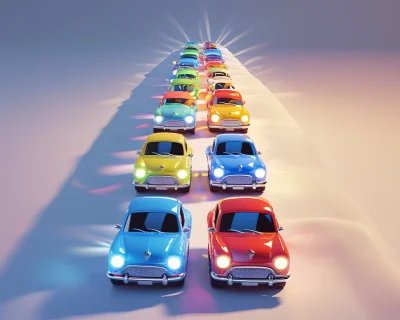
How do I use an art app on a road trip without a meltdown?
Set it up before you leave, mount it near eye level rather than in their lap, and rotate roughly twenty minutes on and twenty off. The reason for the rotation is not screen-time guilt — it is motion sickness, which is what actually goes wrong when a toddler stares down at a fixed screen in a moving car. Pair the app with the window so their focus shifts between near and far: spot a red lorry, then draw it. And do not open it in hour one, or it is spent before the drive gets hard.
Most road-trip app articles skip the thing that actually goes wrong. It is not boredom, and it is not screen-time guilt. It is that somewhere around the ninety-minute mark a child who was perfectly happy goes quiet, then pale, and then you are pulling onto the hard shoulder.
The Part Nobody Mentions
Motion sickness comes from a mismatch. The inner ear reports movement; the eyes, locked on something close and stationary, report stillness. The brain resolves the disagreement by assuming poisoning and doing something about it.
A tablet held low in a lap is close to a worst case: it removes the horizon from view entirely and fixes the gaze on something that is not moving relative to the child. Young children are more susceptible than adults, and toddlers often cannot tell you what is wrong until it is already too late.
This is worth knowing before the drive rather than after, because almost everything below follows from it — and because it explains why "just give them the tablet" fails in a way that has nothing to do with the app.
Stop the app at the first sign
Going quiet after being chatty, looking pale, yawning oddly, asking for the window down, or saying their tummy feels funny. Those are the warning, not the sickness. Take the screen away, open a window, get their eyes on the horizon — at that stage it usually passes.
Set It Up in the Driveway
Five minutes stationary, before anyone is strapped in and impatient:
- Download everything and open it once. Motorways have dead zones, and an app that fetches content mid-journey fails at the worst moment
- Mount it near eye level. A holder on the seat back, or wedged high — anywhere but the lap. This is the single highest-value thing on the list
- Brightness down, sound sorted. Headphones if tolerated, silent mode if not
- Charge, and bring the cable. Obvious, and still the most common thing forgotten
Rotate, Do Not Hand Over
The screen is one item in a rotation, not the journey. Roughly twenty minutes on, then twenty of something else, repeating.
On a six-hour drive most families are well past their usual screen rules, and that is fine — this is not about a daily budget. Rotation is here because continuous downward focus is what makes children car-sick, and because a distraction you have spent cannot be spent again.
Give the App a Job That Involves the Window
The best road-trip activities are the ones that move a child's eyes between near and far, which is the direct opposite of what causes motion sickness. Five that need nothing but what is already there:
- Spot it, then draw it. Find a red lorry out of the window, then draw it in the app. The looking is the activity; the drawing is the reward.
- Count then compose. Count the bridges you go under, then build a beat with that many sounds. Works with the Create & Play DJ mixer, and it gives a number a purpose.
- Colour of the mile. Pick a colour, spot five things that are it, then make a picture using only that colour. Constraint is what makes open-ended tools interesting to a small child.
- Draw where we are going. Not what they see — what they think is at the other end. This one reliably outlasts the others, and it is the only activity here that also handles "are we nearly there".
- Make the soundtrack. A sound for the motorway, a sound for the tunnel, a sound for the roundabout. Then they perform it as you hit each one, which turns the road itself into the game.
What to Rotate To
The off-screen half of the rotation needs to be as planned as the app half, or it becomes twenty minutes of complaint.
- Vehicle spotting. Endless on a motorway, needs no equipment, and gets your child looking at the horizon, which is exactly where you want their eyes. Our spotting guides work as a checklist if you want structure.
- A printed sheet on a clipboard. The on-the-go activities pack is built for this, and paper has one advantage no app has: it does not run out of battery or make anyone sick.
- Audio stories. The only medium that entertains without asking anyone to look down. Underrated for exactly that reason.
- Snacks, deliberately spaced. Not a treat — a scheduled event. Something to look forward to every forty minutes changes the shape of a long drive.
Do Not Open It in Hour One
The most common mistake, and the easiest to avoid. The app comes out in the first twenty minutes because everyone is fresh and it feels harmless, and by hour two the novelty is gone — leaving nothing for the stretch where you genuinely need it.
Hold it back. Snacks and window games first, while their tolerance is high. Bring out the screen for the last third, or the moment things start actually turning. A tool kept in reserve is worth several times one spent early.
The Honest Bit
The best thing on a long drive is not an app. It is a well-timed snack, a stop you did not strictly need, and someone in the back seat talking to your child about what is out of the window.
An app earns its place as one part of a rotation — offline, quiet, held in reserve, and paired with looking out rather than replacing it. That is the version that works. Handed over at the start and left running, it does not, and the problem will not be the app you chose.
If the drive is long enough to include a nap or a bedtime at the far end, the breathing ritual travels too — a car seat is one of the better places to practise it, and one of the more useful places to already have it.

 Ad-free & offline ready