Your three-year-old talks constantly—but half the time, you can't understand what they're saying. Their "truck" sounds like "tuck," their "fish" sounds like "fit," and their "shoe" might be "too." Welcome to the world of articulation challenges.
Here's the reassuring news: most speech sound errors are developmental and resolve with time and practice. And if your child happens to be obsessed with vehicles? You already have the perfect tool for making that practice fun, natural, and actually effective.
This guide will show you how to target specific sounds through vehicle play, organized by the sounds children typically need help with and matched to vehicle activities they'll actually want to do. For general speech practice strategies, start with our comprehensive guide to using vehicle obsession for speech.
Understanding Speech Sound Development
Before diving into activities, it helps to know what's typical. Children acquire different speech sounds at different ages, though there's natural variation (Crowe & McLeod, 2020).
Early Sounds (Ages 2-3)
Typically mastered: P, B, M, H, N, W
Vehicle vocabulary: "Beep," "bus," "boat," "move," "wheel"
Middle Sounds (Ages 3-4)
Developing: T, D, K, G, NG, F, Y
Vehicle vocabulary: "Truck," "taxi," "digger," "car," "go," "fast," "yellow"
Later Sounds (Ages 4-6)
Still emerging: L, S, Z, V, SH, CH, J
Vehicle vocabulary: "Choo-choo," "van," "jeep," "zoom," "small"
Latest Sounds (Ages 5-8)
Last to develop: R, TH (voiced and voiceless)
Vehicle vocabulary: "Tractor," "trailer," "three," "through"
Research shows that children acquire consonant sounds in a relatively predictable order across many languages, though individual children vary (McLeod & Crowe, 2018). Common patterns include stopping (saying "top" for "shop") and gliding (saying "wabbit" for "rabbit"). If your child's sound development is significantly behind these general guidelines, or if others frequently can't understand them, consult a speech-language pathologist for evaluation.
B and P Sounds: Buses, Boats, and Big Trucks
These are often among the first sounds children master because they're produced at the front of the mouth with visible lip movement—easy for children to see and copy (ASHA, 2023).
Target Words
- Initial B: bus, boat, bike, big, blue, beep
- Initial P: plane, park, push, pull, police
Activity: Parking Garage Game
Setup: Create a simple parking garage using blocks or a cardboard box. Label parking spots with pictures or colors.
How to play: Your child "drives" vehicles into parking spots. Each time they park, emphasize the B or P sound: "Park the BIG BLUE BUS!" or "Beep-beep! The Police car goes in the Purple spot!"
Why it works: Repetition happens naturally as vehicles park and unpark multiple times. The game structure gives you dozens of chances to model the target sound without drilling.
Digital Practice
Use Talk & Listen's bus collection to hear clear B sounds. Tap different buses—school bus, city bus, double-decker—while saying "BUS!" together.
T and D Sounds: Trucks, Trains, and Tractors
T and D are produced by tapping the tongue tip against the ridge behind the upper teeth. Children who struggle with these sounds often substitute easier sounds (saying "tar" for "car" or "du" for "do").
Target Words
- Initial T: truck, taxi, tractor, train, tower, two
- Initial D: digger, dump truck, drive, door, down
Activity: Construction Site Drama
Setup: Create a pretend construction site using sand, dirt, or even just blocks to stack and knock down.
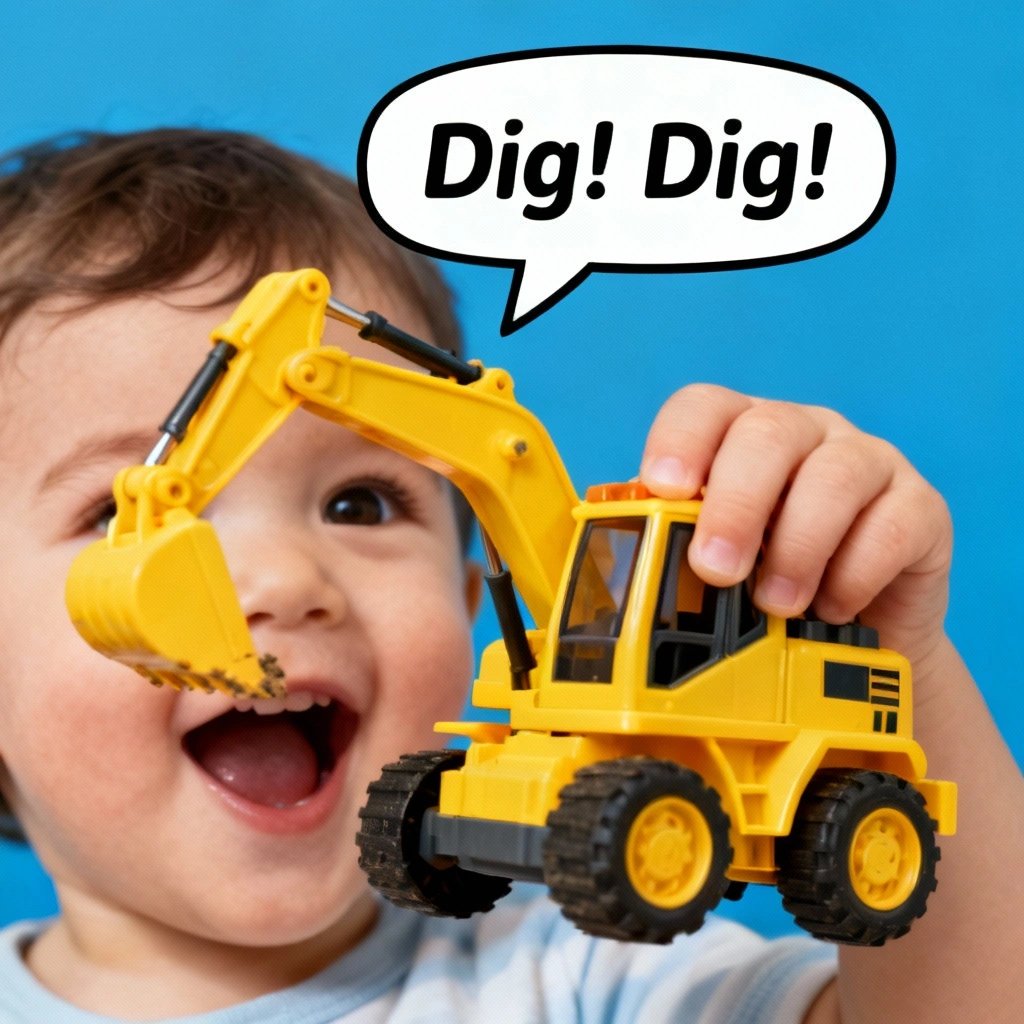
How to play: The dump truck dumps dirt, the digger digs holes, the tractor moves across the site. Narrate with emphasized T and D sounds: "The DUMP truck DUMPS the Dirt! The Tractor pulls the Trailer!"
Why it works: Construction vehicles naturally have T/D-heavy vocabulary. The repetitive actions (dump, dig, lift, drop) provide multiple practice opportunities per minute of play.
CH Sounds: Choo-Choo Trains
The CH sound (as in "choo-choo") is one of the later-developing sounds. According to research on consonant acquisition, CH is typically mastered between ages 3.5-5 years (Crowe & McLeod, 2020). Train play is your best vehicle-based opportunity to practice this sound.
Target Words
- CH sound: choo-choo, chugga, train (when emphasizing the sound)
- Related words: choose, change, charge
Activity: Train Track Adventures
Setup: Use toy train tracks or create tracks with tape on the floor. Add stations (blocks), bridges (books), and tunnels (boxes).
How to play: As the train moves, make exaggerated "CHUGGA-CHUGGA CHOO-CHOO!" sounds together. Pause at each station and restart with the sound. Make it rhythmic and fun—CH sounds have a great musical quality.
Why it works: The repetitive, rhythmic nature of train sounds makes this feel like a game or song rather than practice. Children naturally want to keep the game going, which means more repetitions.
V Sounds: Vans and Vroom-Vrooms
The V sound involves light contact between upper teeth and lower lip—a motor pattern that takes time to develop, typically mastered around age 4 (ASHA, 2023).
Target Words
- Initial V: van, vroom, vehicle, very
- Common in play: "vroom vroom," "moving van," "delivery van"
Activity: Van Delivery Service
Setup: Gather small toys or blocks to be "packages." Create delivery stops around the room.
How to play: The van delivers packages to different locations. Each time it drives, make the "VROOM VROOM!" sound together. "The VAN delivers a Very important package! VROOM VROOM all the way!"
Why it works: "Vroom" is already a favorite word for most vehicle-loving kids, so you're practicing a sound they're motivated to make correctly.
K and G Sounds: Cars and Go-Go-Go
K and G are back-of-the-mouth sounds that require lifting the back of the tongue to meet the soft palate. When children struggle with these, they often substitute T/D sounds ("tar" instead of "car").
Target Words
- Initial K: car, keys, color, kick, come
- Initial G: go, gas, garage, green, garbage truck
Activity: Race Track and Garage
Setup: Create a simple race track loop using tape or toy track pieces. Add a garage where cars rest.
How to play: Cars start in the garage. On "GO!" they race around the track, then Come back to the garage. "Ready, set, GO! The Green Car goes fast! The red Car goes too! Now they Come back to the Garage!"
Why it works: Racing naturally incorporates "GO!" which is a pure G sound, and parking incorporates "CAR" repeatedly. The excitement of racing helps produce clear, strong sounds.
Digital Extension
In Talk & Listen, tap different colored cars while saying "CAR!" together. The color words also give you practice: "Green car! Gold car!"
SH Sounds: Whoosh and Shiny
SH is a later sound (typically ages 3.5-5) that requires precise tongue positioning and a sustained airflow. It's heard frequently in vehicle play contexts.
Target Words
- Initial SH: shiny, ship
- Related sounds: "whoosh" (for airplanes), "shh" (quiet car game)
Activity: Car Wash
Setup: Create a pretend car wash using a shoebox tunnel decorated with streamers or scarves. Add pretend soap (play foam) if desired.
How to play: Drive vehicles through the car wash, making "WHOOSH" and "SHHHH" sounds for the water and air. "The SHiny car goes through! WHOOSH goes the water! SHHH goes the dryer! Now it's SHiny and clean!"
Why it works: The SH sound feels naturally paired with water and wind sounds, so it doesn't feel like artificial practice—it's just good sound effects for play.
Making Practice a Daily Routine (Without It Feeling Like Work)
The secret to effective at-home articulation practice is consistency without pressure. Research on motor learning in speech shows that frequent, shorter practice sessions are more effective than infrequent long sessions (Preston, Leaman, & Maas, 2021). Here's how to make it sustainable:
Keep It Short
10 minutes of focused, fun practice beats an hour of frustrated drilling. Set a timer if it helps—when the timer goes off, practice is done for now. This keeps it feeling special rather than endless.
End on Success
Always finish practice with something your child did well—even if it's just making the sound once or trying hard. You want them to walk away feeling good about practice so they're willing to do it again tomorrow.
Use Real Conversations Too
Structured practice builds the motor skill, but the real goal is using sounds in everyday speech. Throughout the day, emphasize target sounds naturally: "Let's put on your SHoes!" or "Time to GO to the CAR!"
Celebrate Progress, Not Perfection
Notice when your child's pronunciation is clearer, even if not perfect. "I understood that word right away! You said 'truck' so clearly!" This reinforces effort and builds confidence.
When to Involve a Professional
At-home practice is powerful, but it's not always enough. According to ASHA practice guidelines (2023), consider consulting a speech-language pathologist if:
- Your child's speech is significantly less clear than same-age peers
- They're frustrated by not being understood
- Multiple sounds are delayed or distorted
- Progress isn't happening after 2-3 months of consistent practice
- Your child is older than the typical age for mastering a sound they still struggle with
- Your child has difficulty with the motor planning of speech movements (may indicate apraxia)
A speech therapist can assess exactly which sounds need work, identify any underlying issues (like tongue-tie or motor planning challenges), and create a customized treatment plan. Your vehicle-based practice at home will then complement professional therapy (Rvachew & Brosseau-Lapré, 2018).
For more comprehensive guidance on speech milestones, see our article: Using Your Toddler's Vehicle Obsession to Boost Speech → For tracking which words your child is developing, use our vehicle vocabulary checklist. If you're working with a bilingual child, see how Spanish introduction complements articulation practice.
The Long Game: From Sounds to Clear Speech
Learning to produce speech sounds clearly is a gradual process. Your child will first produce the sound in isolation ("Ssss"), then at the beginning of simple words ("Sun"), then in longer words and phrases, and finally in conversation without thinking about it. Track this progression using our vocabulary development checklist.
That process takes months or even years for some sounds—and that's okay. Your role isn't to speed up development artificially, but to provide rich practice opportunities that make the natural process more efficient and fun.
By anchoring that practice in something your child already loves—vehicles—you're removing resistance and adding joy. The fire truck that helps them learn the F sound today might be the first word they read tomorrow. Every little victory builds toward confident, clear communication.
So pull out those toy cars. Set up that train track. Make those exaggerated engine sounds. You're not just playing—you're building the foundation for a lifetime of clear, confident speech.
References
- American Speech-Language-Hearing Association. (2023). Speech Sound Disorders: Articulation and Phonology. ASHA. https://www.asha.org/practice-portal/clinical-topics/articulation-and-phonology/
- Bowen, C. (2021). Children's Speech Sound Disorders (3rd ed.). Wiley-Blackwell. https://www.speech-language-therapy.com/
- Crowe, K., & McLeod, S. (2020). Children's English consonant acquisition in the United States: A review. American Journal of Speech-Language Pathology, 29(4), 2155-2169. https://doi.org/10.1044/2020_AJSLP-19-00168
- McLeod, S., & Crowe, K. (2018). Children's consonant acquisition in 27 languages: A cross-linguistic review. American Journal of Speech-Language Pathology, 27(4), 1546-1571. https://doi.org/10.1044/2018_AJSLP-17-0100
- Rvachew, S., & Brosseau-Lapré, F. (2018). Developmental Phonological Disorders: Foundations of Clinical Practice (2nd ed.). Plural Publishing. https://www.pluralpublishing.com/

 Ad-free & offline ready