Press Release: Read on EIN Presswire →
Download this report
Print-friendly PDF version for sharing
What is the state of toddler educational apps in 2025?
The toddler educational app market generated over $6 billion in 2024, with 68% of children ages 0-8 using tablets regularly. However, academic research reveals a critical gap: high App Store ratings do not correlate with verified educational effectiveness. A peer-reviewed study of 124 apps found most scored below quality thresholds, with free apps performing significantly worse due to ad-related distractions. The industry has standardized on $59.99/year subscriptions, costing parents $180-540 over a typical 3-year usage period. COPPA 2025 amendments require separate opt-in consent for targeted advertising by April 2026, following a $10 million Disney settlement.
Executive Summary
The mobile application market for early childhood education represents one of the most commercially successful—and academically scrutinized—segments of the app economy. With over $6 billion in revenue generated in 2024 and 68% of children ages 0-8 regularly using smartphones and tablets, the stakes for getting this right have never been higher.
This report presents a comprehensive analysis of the toddler app landscape in 2025, drawing on competitive intelligence from 33 leading applications, peer-reviewed academic research, and the latest regulatory developments from the Federal Trade Commission. The findings reveal a market characterized by a fundamental tension: commercial success metrics (App Store ratings, download volume) bear little relationship to verified educational effectiveness.
Key Finding
A 2021 study of 124 "educational" apps found that most scored below quality thresholds on the Four Pillars of Learning framework. Free apps performed significantly worse due to "distracting enhancements"—the very ads and interruptions that fund their business model. (See also: What "Research-Backed" Actually Means)
The regulatory environment is shifting dramatically. The FTC's 2025 COPPA amendments require separate opt-in consent for targeted advertising to children, prohibit indefinite data retention, and establish April 22, 2026 as the compliance deadline. Recent enforcement actions—including a $10 million Disney settlement and ongoing litigation against apps that collected data from over 116,000 children without consent—signal aggressive regulatory intent.
For parents navigating this landscape, the implications are clear: high ratings and popular brands do not guarantee educational value or privacy protection. The apps that score highest on academic quality metrics are often those that reject the dominant subscription model entirely—nonprofit alternatives like Khan Academy Kids and one-time purchase apps from independent developers.
The Market Landscape: $6 Billion and Growing
The educational app market generated over $6 billion in 2024, with 68% of children ages 0-8 using tablets regularly and 40% owning their own device by age 2.
Device Saturation and Screen Time
The foundation of the toddler app market is the remarkable penetration of mobile devices into early childhood. Current statistics paint a picture of near-universal access:
This level of device saturation transforms the mobile device from a supplementary tool into an integrated daily utility. When toddlers spend 90+ minutes per day on screens, parents are willing to pay for perceived safety and quality—creating the economic foundation for premium pricing.
Market Valuation
The educational app sector generated over $6 billion in revenue in 2024, driven by the digitization of learning tools across all age groups. The early childhood segment (ages 0-6) represents a particularly valuable cohort due to:
- High parental willingness to pay for "educational" content
- Limited ability of young children to distinguish ads from content
- Strong emotional drivers (parental anxiety about school readiness)
- Recurring revenue potential during the 3-4 year "toddler window"
The Brand Advantage
A distinguishing characteristic of top-ranking apps is their reliance on established intellectual property and brand recognition. The top 50 apps frequently include:
- Media franchises: Barbie, Disney, PJ Masks, LEGO DUPLO
- EdTech brands: Toca Boca, Sago Mini, Kiddopia, Khan Academy
- Public media: PBS Kids, Sesame Workshop
For apps without external IP, developing an equally potent brand identity is necessary to compete with the marketing muscle of mainstream media giants. Brand recognition serves as a surrogate for detailed parental vetting—parents trust familiar names, even when that trust may not be warranted by the app's actual educational design.
The Subscription Economy: Why Parents Pay $180-540 Over Three Years
The toddler app industry has standardized on $59.99/year subscriptions, with only 16% of users converting to paid—driving aggressive monetization tactics that cost parents $180-540 over a typical 3-year usage period.
The $59.99 Standard
The toddler app market has converged on a remarkably consistent pricing structure. Our analysis of 33 leading applications reveals that the subscription model dominates, with a standardized price point of approximately $59.99 per year (or $7.99-$14.99 monthly).
| App | Price Model | Annual Cost | 3-Year Cost |
|---|---|---|---|
| ABCmouse | Subscription | $59.99 | $180+ |
| Speech Blubs | Subscription | $59.99 | $180 |
| Lingokids | Subscription | $71.99–179.88 | $216–540 |
| HOMER | Subscription | $120 | $360 |
| Epic! | Subscription | $79.99+ | $240+ |
| Khan Academy Kids | Free (Nonprofit) | $0 | $0 |
| Endless Alphabet | One-time | $8.99 | $8.99 |
| Teach Your Monster | One-time | $8.99 | $8.99 |
| Little Wheels | One-time | $4.99 | $4.99 |
| Daniel Tiger for Parents | One-time | $2.99 | $2.99 |
3-Year Cost Comparison: Subscription vs One-Time Purchase
Why Subscriptions Dominate: The 16% Problem
The subscription model's dominance is a strategic response to a challenging conversion environment. In 2024, the conversion rate for education apps on iOS was only 16%—relatively low compared to other app categories.
Given this low conversion rate, developers must maximize revenue from every converted user. The $59.99 annual price point is psychologically calibrated: it's comparable to other enrichment activities (a month of music lessons, a few books) and can be justified as an investment in a child's education.
The target audience (ages 2-5) also has a limited subscription lifetime. A child who starts using an app at age 2 will likely age out by age 5-6, giving developers a maximum 3-4 year window to capture revenue. This creates pressure to extract maximum value quickly.
The Friction Problem
Despite high overall ratings, recurring negative review themes focus on subscription friction. Common complaints include:
- "Annoying subscription" prompts and unexpected paywalls
- Difficulty canceling or managing subscriptions
- Content locked behind additional purchases after paying for subscription
- Auto-renewal traps and confusing trial periods
This indicates that while the high-value subscription model is standard, the operational execution of the freemium conversion funnel remains a major source of consumer frustration.
Follow the Money: Ownership, Funding, and Geographic Patterns
Many popular toddler apps that appear American are actually headquartered in Slovenia, Turkey, Spain, or India, while others are backed by private equity firms with $300M+ in funding from sources including sovereign wealth funds.
The Global Developer Landscape
Many parents assume the apps their children use are developed by American companies. Our analysis reveals a more complex picture. While some apps maintain US legal entities, their actual development and data operations are often based elsewhere. (For a visual breakdown, see Where Does Your Child's Data Go?)
| App | Appears To Be | Actual HQ | Funding |
|---|---|---|---|
| Speech Blubs | US (Delaware) | Ljubljana, Slovenia | $3.89M (Austrian VC) |
| Otsimo | US (SF office) | Ankara, Turkey | $2M (Turkish VCs) |
| Lingokids | US (Delaware/SF) | Madrid, Spain | $62-186M (28 investors) |
| Montessori Preschool | — | France | Unknown |
| ABCmouse | US | Glendale, CA | $300M+ (TPG + Qatar) |
| HOMER | US | New York, NY | $50M+ (LEGO Ventures) |
Capital Structure Analysis: Who Owns the Apps Your Child Uses?
From an investment banking perspective, the toddler app market exhibits a clear bifurcation in capital structure that directly correlates with business model choices:
| Ownership Type | Apps | Total Capital | Business Model | Data Strategy |
|---|---|---|---|---|
| PE/Sovereign Wealth | ABCmouse | $300M+ ($3B valuation) | Subscription | Heavy collection |
| VC-Backed (Series C+) | Lingokids, HOMER | $50-186M | Subscription | Moderate-Heavy |
| VC-Backed (Seed/A) | Speech Blubs, Otsimo | $2-4M | Subscription | Moderate |
| Nonprofit | Khan Academy Kids, PBS, Sesame | Donation-funded | Free | Minimal |
| Self-Funded Indie | Endless Alphabet, Little Wheels | Bootstrapped | One-time purchase | Minimal/None |
Key insight: There is a near-perfect correlation between funding source and monetization strategy. Apps with external capital obligations (PE, VC) universally adopt subscription models with heavier data collection. Apps without investor return requirements (nonprofits, bootstrapped) can optimize for user value rather than recurring revenue extraction.
Market Segmentation by Ownership Type (33 Apps Analyzed)
The Private Equity Factor
Several of the largest toddler apps are backed by private equity firms and sovereign wealth funds. ABCmouse, for example, is owned by Age of Learning, which received over $300 million in funding from TPG Capital and the Qatar Investment Authority, reaching a $3 billion valuation. (See our detailed analysis: Parent-Built vs. Private Equity)
This ownership structure has implications for product decisions. PE-backed companies face pressure to maximize returns within specific timeframes, which can incentivize:
- Aggressive subscription conversion tactics
- Data monetization strategies
- Cost reduction in content development
- Prioritizing engagement metrics over educational outcomes
The Indie Alternative
In contrast, several high-performing apps are developed by small, independent teams or nonprofits:
- Endless Alphabet — 5-person team (Originator Inc.), self-funded, profitable since launch
- Khan Academy Kids — Nonprofit, donation-funded, completely free, 4.9★ rating
- Teach Your Monster — UK charity (Usborne Foundation), one-time $8.99
- DragonBox — Acquired by Kahoot!, maintains one-time pricing model
- Little Wheels — Solo founder (Sean Record), bootstrapped, $4.99 one-time, zero data collection
- Daniel Tiger for Parents — PBS Kids nonprofit, $2.99 one-time, Fred Rogers methodology
These apps consistently score higher on user satisfaction metrics related to pricing transparency and absence of aggressive monetization tactics. Notably, the bootstrapped and nonprofit segments demonstrate that sustainable businesses can be built without external capital—and the resulting freedom from investor return requirements enables product decisions optimized for child outcomes rather than revenue extraction.
Market Segmentation Insight
The toddler app market is effectively a barbell distribution: large PE/VC-backed subscription apps at one end, and small bootstrapped/nonprofit one-time purchase apps at the other.
Should You Download That Toddler App?
Privacy, Data Collection, and the COPPA 2025 Reset
The FTC's 2025 COPPA amendments require separate opt-in consent for targeted advertising by April 22, 2026, following a $10 million Disney settlement and litigation against apps that collected data from 116,000+ children without consent.
The Current State of Children's Data
Our analysis of 33 leading toddler apps reveals significant variation in data collection practices:
| Data Collection Level | % of Apps | Examples |
|---|---|---|
| Heavy | ~35% | ABCmouse, Lingokids, Epic! |
| Moderate | ~30% | HOMER, Montessori Preschool |
| Unclear | ~15% | Speech Blubs, Otsimo |
| Minimal/Zero | ~20% | Endless Alphabet, Teach Your Monster, Khan Academy, Little Wheels |
Data Collection in Top 33 Toddler Apps
Detailed Privacy Comparison: Top Apps by Data Collection
Apple's App Store privacy labels provide transparency into what data each app collects. Here is a detailed breakdown of the top apps in our analysis:
| App | Contact Info | Identifiers | Usage Data | Account Required | Offline Mode |
|---|---|---|---|---|---|
| ABCmouse | ✓ | ✓ | ✓ | Yes | No |
| Lingokids | ✓ | ✓ | ✓ | Yes | Partial |
| Speech Blubs | Unclear | Unclear | ✓ | Yes | No |
| HOMER | Unclear | Unclear | Unclear | Yes | No |
| Khan Academy Kids | — | — | Minimal | Yes | Partial |
| Endless Alphabet | — | — | Minimal | No | Yes |
| Little Wheels | — | — | — | No | Yes (100%) |
| Teach Your Monster | — | — | Minimal | No | Yes |
The 2025 COPPA Amendments
The Federal Trade Commission finalized major amendments to the Children's Online Privacy Protection Act (COPPA) Rule in January 2025. These represent the most significant update since 2013 and fundamentally change how apps can collect and monetize children's data.
Key COPPA 2025 Changes
- Separate opt-in consent required for targeted advertising
- Indefinite data retention prohibited — must specify deletion timeframes
- Comprehensive security programs now mandatory
- Third-party SDK liability — operators responsible for vendor data collection
- Compliance deadline: April 22, 2026
Recent Enforcement Actions
The FTC has signaled aggressive enforcement intent through several high-profile actions in 2024-2025:
Disney/YouTube Settlement — $10 Million
Disney failed to properly designate child-directed content on YouTube, enabling data collection without parental consent. Establishes platform accountability for content classification failures.
Sendit App — Federal Litigation
Collected data from 116,000+ children under 13 without consent. Combined with deceptive practices (fake messages, misleading subscription benefits). CEO personally named in lawsuit.
Apitor Technology — SDK Liability
Third-party SDK (JPush) collected children's geolocation data without disclosure. Establishes that operators are liable for vendor data collection, even if unintentional.
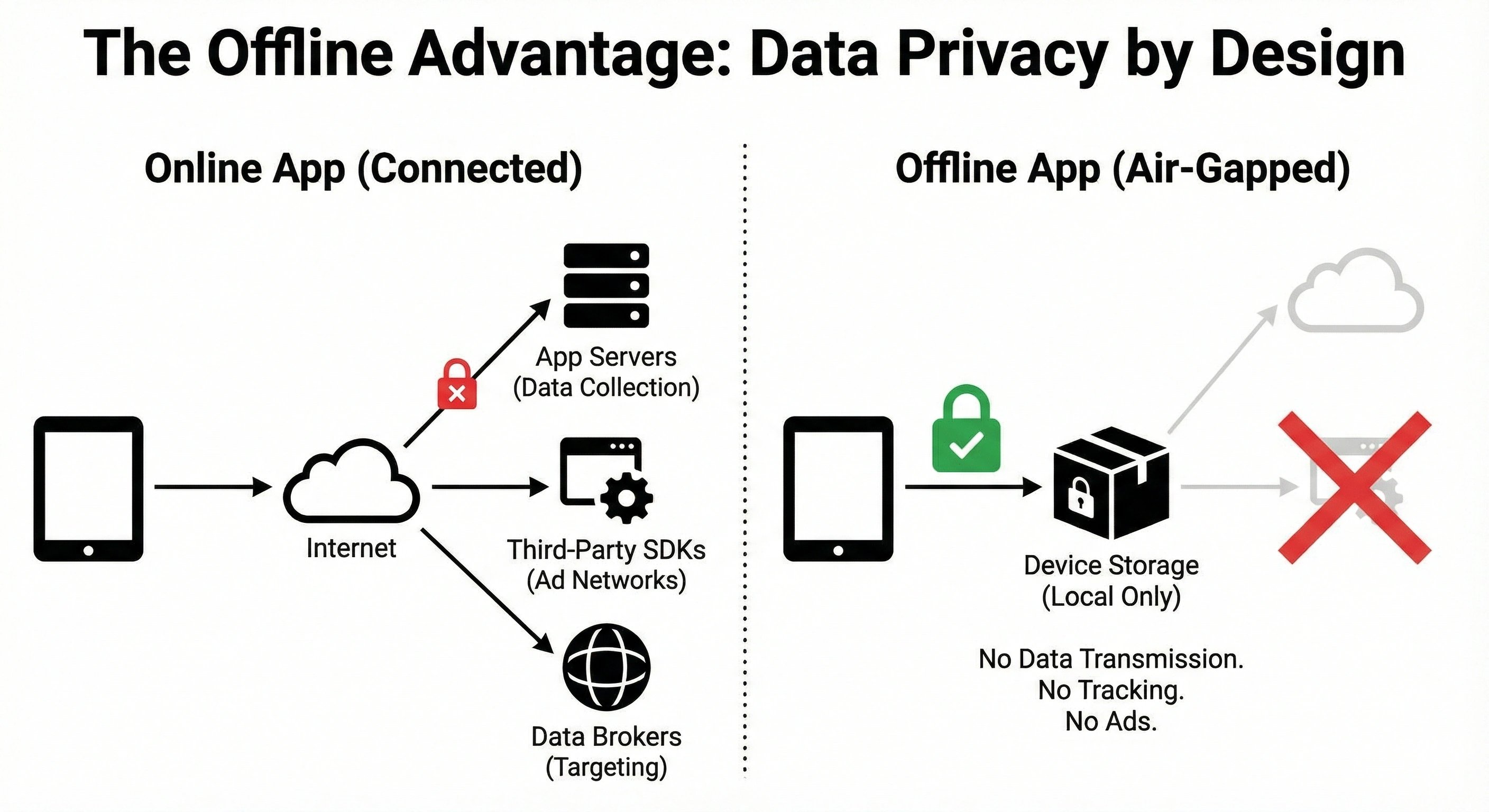
The Offline Advantage
Apps that operate 100% offline have a structural compliance advantage. With no network connection, there is no mechanism for data transmission to third parties. Our analysis found that only about 20% of top apps offer full offline functionality:
- Full offline: Endless Alphabet, Teach Your Monster, DragonBox, some indie apps
- Partial offline: Khan Academy Kids, Lingokids, Epic!
- Online required: ABCmouse, Speech Blubs, Otsimo, HOMER
The Educational Quality Gap: When 4.5 Stars Doesn't Mean Quality
A peer-reviewed study of 124 "educational" apps found most scored below quality thresholds on the Four Pillars of Learning framework, with free apps performing significantly worse due to "distracting enhancements" like ads.
The Four Pillars Study
In 2021, researchers McLaren, Robb, McCafferty, Hirsh-Pasek, Zosh and colleagues published a landmark study analyzing 124 popular children's educational apps using the Four Pillars of Learning framework. The framework evaluates apps on:
- Active Learning: Does the app require thinking, not just cause-and-effect tapping?
- Engagement: Is the child engaged in the learning process itself?
- Meaningful Learning: Does content connect to everyday experiences?
- Social Interaction: Does the app facilitate interaction with caregivers or characters?
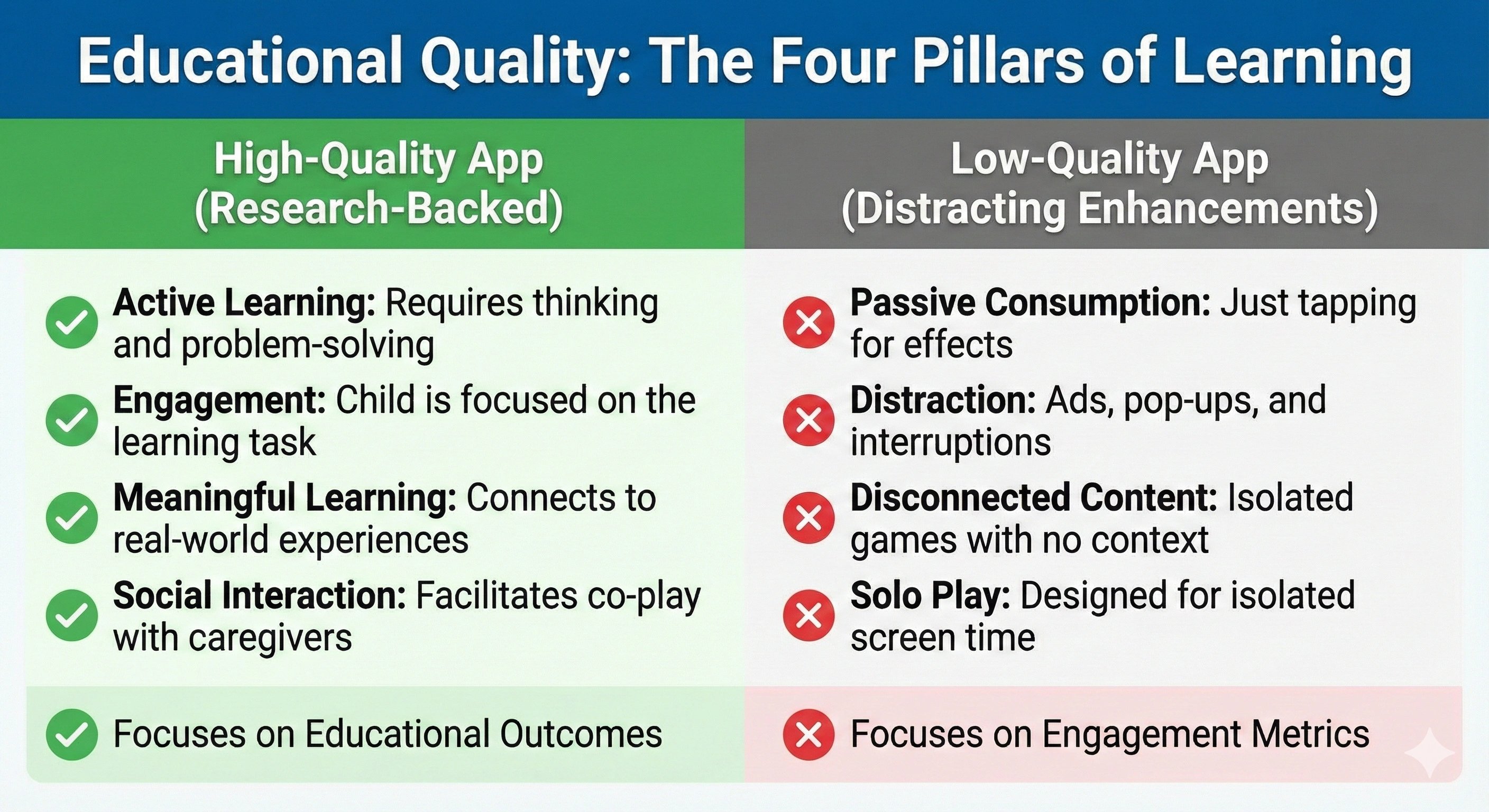
Each pillar was scored 0-3, for a maximum score of 12. Apps scoring ≤4 were considered lower quality.
Key Finding
Overall scores were low across all pillars. Most apps fell below the mid-level threshold, reflecting moderate to low educational quality by these criteria—despite having high App Store ratings.
Free Apps Score Worse
A critical finding: free apps scored significantly lower than paid apps, particularly on the Engagement pillar. The researchers attributed this to "distracting enhancements"—the ads, pop-ups, and interruptions that fund free apps but actively interfere with learning.
This creates a paradox: the apps most accessible to families (free) are often the least educationally effective. The $59.99 subscription model, whatever its other flaws, at least removes the ad-based distractions that demonstrably harm learning outcomes.
The "Research-Backed" Problem
Many apps claim to be "research-backed" or "developed with experts." Our analysis of these claims reveals significant variation in their substance:
| App | Claim | Verification |
|---|---|---|
| Khan Academy Kids | Stanford collaboration | ✓ Verified |
| Moshi Kids | NYU sleep study | ✓ Verified |
| Teach Your Monster | UK charity, educator-designed | ✓ Verified |
| Speech Blubs | "SLP-designed, evidence-based" | ⚠ Marketing claim |
| HOMER | "74% reading improvement" | ⚠ Internal study |
| ABCmouse | "Research-backed" | ⚠ Generic claim |
The distinction matters: apps with genuine university partnerships (Khan/Stanford, Moshi/NYU) have external validation of their methods. Apps making generic "research-backed" claims without citing specific studies are using marketing language, not scientific evidence.
Navigating the Landscape: Recommendations
For Parents
- Don't trust ratings alone. High App Store ratings correlate with engagement and brand recognition, not educational effectiveness. A 4.5-star app may score poorly on validated learning frameworks.
- Check the privacy label. Apple's App Store shows what data each app collects. Look for "Data Not Collected" or minimal data collection. Be wary of apps collecting "Contact Info," "Identifiers," or "Usage Data."
- Consider one-time purchase alternatives. Apps like Endless Alphabet ($8.99), Teach Your Monster ($8.99), and Khan Academy Kids (free) avoid the subscription model entirely while maintaining high quality.
- Verify "research-backed" claims. Ask: Is there a specific university partnership? Is there a published study? Generic claims without citations are marketing, not science.
- Prioritize offline capability. Apps that work without internet have structural privacy advantages and work during travel, in waiting rooms, and at grandma's house. See our best offline apps for kids comparison for apps that passed 30-day airplane mode testing.
For Developers
- Prepare for COPPA 2026. The April 22, 2026 compliance deadline requires separate opt-in consent for targeted advertising, published data retention policies, and comprehensive security programs. Start now.
- Audit third-party SDKs. The Apitor case establishes that you are liable for data collection by embedded vendors. Conduct technical audits of all integrated code.
- Consider alternative business models. One-time purchase apps (Endless Alphabet) and nonprofit models (Khan Academy) demonstrate that sustainable businesses can be built without subscription pressure or data monetization.
- Invest in genuine educational design. As the market matures, differentiation will come from demonstrable learning outcomes, not just engagement metrics. Consider partnerships with academic institutions.
For Policymakers
- Extend protections to teenagers. COPPA covers children under 13, but adolescents face similar privacy risks. State laws like the Maryland Kids Code are filling this gap.
- Require educational efficacy disclosure. Apps marketed as "educational" should be required to disclose whether their claims are based on peer-reviewed research, internal studies, or marketing assertions.
- Address the free app paradox. The apps most accessible to low-income families (free, ad-supported) are demonstrably less effective educationally. This creates an equity issue in early childhood education.
Methodology and References
Data Sources
This report draws on multiple data sources:
- Competitive analysis: 33 leading toddler and early childhood apps, with data on pricing, ownership, privacy practices, and user reviews
- Academic research: Peer-reviewed studies on educational app effectiveness, particularly the Four Pillars framework
- Regulatory sources: FTC announcements, Federal Register publications, and enforcement action documents
- Industry reports: Market sizing and growth projections from EdTech analysts
Key References
McLaren, C., Robb, M., McCafferty, H., Hirsh-Pasek, K., Zosh, J. et al. (2021). "How educational are 'educational' apps for young children? App store content analysis using the Four Pillars of Learning framework." Journal of Children and Media.PMC8916741
Federal Trade Commission. (2025). "Children's Online Privacy Protection Rule: Final Amendments." Federal Register, April 22, 2025.Federal Register
Hirsh-Pasek, K., Zosh, J.M., Golinkoff, R.M., Gray, J.H., Robb, M.B., & Kaufman, J. (2015). "Putting Education in 'Educational' Apps: Lessons From the Science of Learning."Psychological Science in the Public Interest, 16(1), 3-34.
Limitations
This analysis has several limitations:
- App Store data reflects a snapshot in time; prices and features change frequently
- Privacy practices are assessed based on public disclosures, not technical audits
- Educational quality assessments rely on published research, which may not cover all apps analyzed
- Ownership and funding information is based on publicly available sources and may be incomplete
About This Report
This report was compiled by Little Wheels, an independent developer of educational apps for toddlers. While I have endeavored to present objective analysis, readers should be aware that Little Wheels competes in this market with one-time purchase, offline-first, zero-data-collection apps.
For questions, corrections, or additional data requests, contact:sean@recordcreativeco.com
Further Reading
Explore related analysis and guides from Little Wheels:
Learn more
- Where Does Your Child's Data Go? Kids' App HQ Map12 mins
We mapped 20+ kids' app headquarters—from Slovenia to Qatar. See which apps collect data and which keep your child's info private.
- Are 'Certified Safe' Kids Apps Really Safer?11 mins
Some kids apps pay thousands per year for 'certified safe' badges like kidSAFE and other awards. This parent guide explains what those badges actually mean, what they cost, and why truly safe, zero-data apps may not have any badges at all.
- Parent-Built vs. Private Equity: Who's Really Making Your Kid's Apps?14 mins
Follow the money behind kids' apps. We mapped ownership of 25+ popular apps—from $3B PE-backed giants to solo parent developers. See who's behind ABCmouse, Speech Blubs, HOMER, and more.
- What 'Research-Backed' Actually Means in Kids' Apps12 mins
I audited the research claims of 15+ kids' apps. Most are marketing language, not peer-reviewed science. Here's how to tell the difference.
- Calm Tech vs. Dopamine Loops in Kids' Apps13 mins
I analyzed 25+ kids' apps for stimulation level and design philosophy. See which apps use calm, open-ended play vs. high-stimulation reward loops designed to maximize engagement.
 Frequently Asked Questions
 Ad-free & offline ready